Best Roofing Options for Arizona Heat
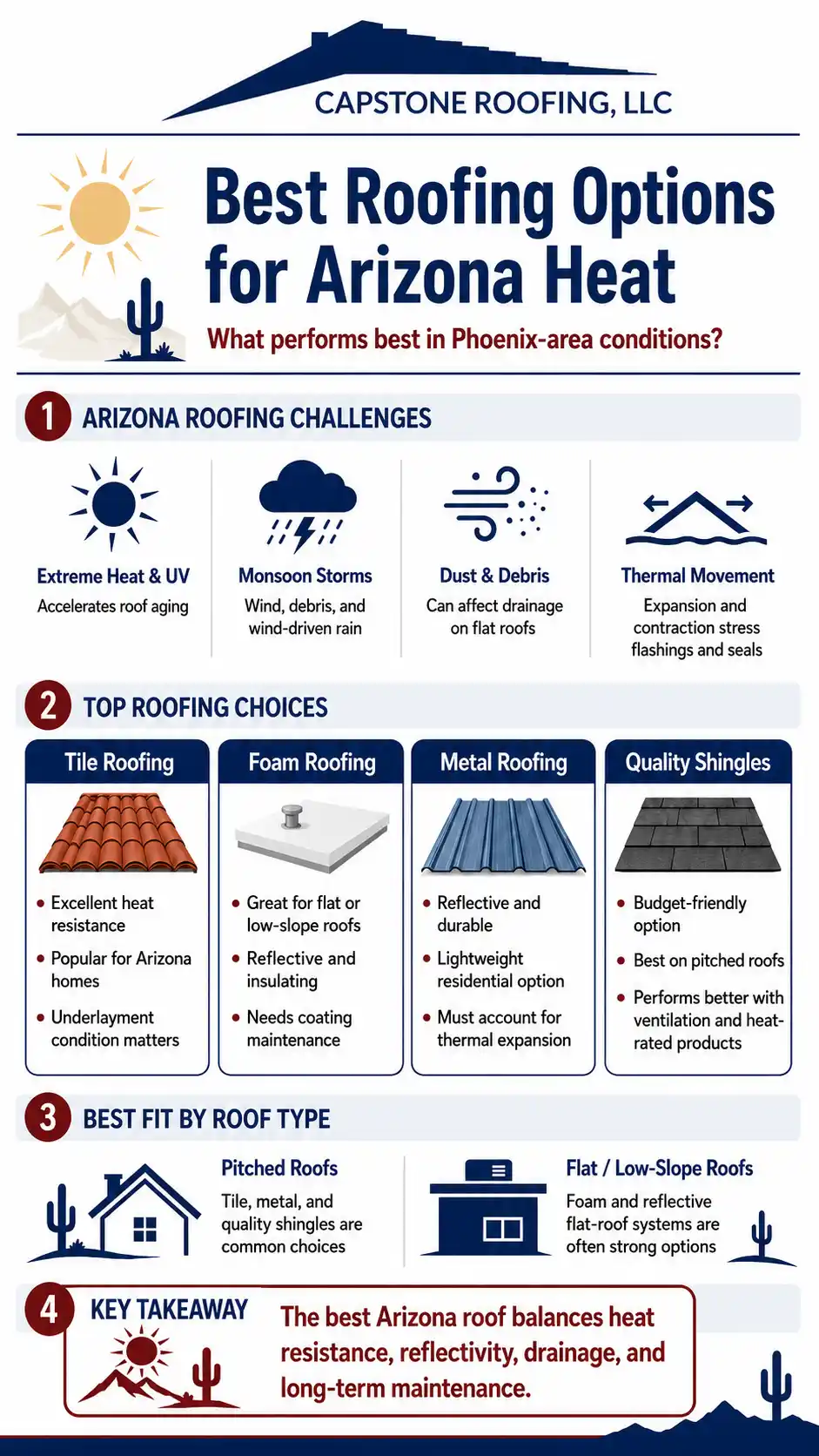
The best roofing options for Arizona heat are tile, foam, and metal roofing. Tile performs well on pitched roofs because it handles intense sun and heat. Foam roofing is a strong choice for flat and low-slope roofs because it adds insulation and reflectivity. Metal roofing can also perform well when it has a reflective coating and is installed to handle thermal expansion. High-quality shingles can work, but they are more heat-sensitive than tile, foam, or metal.
Choosing the best roofing options for Arizona heat is different from choosing a roof in a cooler or wetter part of the country. In Phoenix and across the Valley, a roof has to deal with long stretches of extreme sun, high UV exposure, dust, thermal expansion, and sudden monsoon storms. A material that works well in a mild climate may age faster here if it absorbs too much heat, expands and contracts heavily, or cannot handle wind-driven rain.
That is why Arizona homeowners often compare tile, foam, metal, shingles, flat roofing systems, coatings, and energy-efficient roof materials before making a decision. The right roof type depends on your home’s structure, roof slope, budget, insulation needs, neighborhood style, and long-term maintenance expectations. There is no single roof that is perfect for every Arizona home, but some materials consistently perform better in desert conditions than others.
This guide explains the best roof type for Arizona homes, what to look for in heat-resistant roofing, why flat roofs are common in Arizona, whether roofing should be done in the winter, and how to think about roof replacement cost in a hot desert climate.
Why Arizona Heat Changes Which Roofing Options Work Best
Arizona roofing systems face a combination of heat, sunlight, dust, and storm activity that can shorten the life of materials that are not selected or installed correctly. During the summer, roof surfaces can become much hotter than the outdoor air temperature. Darker roofing materials absorb more solar energy, which can raise attic temperatures, increase cooling demand, and accelerate material aging.
Heat affects roofing in several ways. Asphalt can dry out, soften, harden, and lose granules over time. Roof coatings can chalk, thin, or crack if they are not maintained. Foam roofs rely on protective coatings to shield the foam from UV exposure. Tile roofs handle heat well, but the underlayment beneath the tiles can age faster in Arizona than it might in a milder climate. Metal roofing can perform very well in the heat, but it must be installed with expansion and contraction in mind.
Solar reflectance and thermal emittance are two important concepts when comparing roofing materials. Solar reflectance measures how much sunlight a roof reflects, while thermal emittance measures how well the surface releases absorbed heat. The ENERGY STAR explanation of cool roof performance describes how reflective and heat-emitting roof surfaces can reduce heat transfer into homes and buildings. The U.S. Department of Energy guide to cool roofs also explains how cool roofing products can help lower roof temperatures in sunny climates.
In Arizona, those concepts matter because roofs are exposed to sun for so much of the year. A cooler roof surface may help reduce heat movement into the attic or interior space, especially when paired with proper insulation and ventilation. This is why many Arizona homeowners compare energy-efficient roofing options before choosing a replacement system.
What Makes a Roofing Material Good for Arizona?
The best roofing material for Arizona is not only about heat resistance. A strong desert roof needs several qualities working together. It should handle UV exposure, shed or manage water during monsoon storms, stay stable during thermal movement, and match the slope and structure of the home.
A good Arizona roofing material should offer:
- Heat resistance: The material should resist cracking, drying, warping, or softening under prolonged summer sun.
- Reflectivity: Lighter or reflective surfaces can help reduce heat absorption.
- Durability: The roof should stand up to wind, debris, and seasonal storm exposure.
- Compatible installation: Tile, foam, metal, shingles, and flat roof membranes all need different installation details.
- Drainage control: Flat and low-slope roofs need clear drainage paths to reduce ponding.
- Maintenance access: Some roofs need periodic recoating, inspection, or tile replacement.
- Energy performance: The roof should work with attic ventilation, insulation, and building orientation.
When comparing options, avoid choosing based only on the lowest upfront price. A roof that costs less at installation may require more frequent repair, earlier replacement, or more maintenance in the Arizona climate. For a broader comparison of materials, Capstone Roofing’s guide to the best roofing materials for Arizona is a helpful companion resource.
| Roofing Option |
Best For |
Heat Performance |
Key Arizona Consideration |
| Tile Roofing |
Pitched residential roofs |
Excellent |
Underlayment ages beneath the tiles |
| Foam Roofing |
Flat and low-slope roofs |
Excellent |
Protective coating must be maintained |
| Metal Roofing |
Residential and commercial roofs |
Very good |
Needs proper expansion and contraction details |
| Asphalt Shingles |
Budget-conscious pitched roofs |
Moderate |
Arizona heat can shorten lifespan |
| Built-Up / Modified Bitumen |
Flat commercial roofs |
Good with reflective coating |
Drainage and coating condition matter |
Tile Roofing: One of the Best Roof Types for Arizona Homes
Tile roofing is one of the most common and recognizable roof types in Phoenix, Scottsdale, Mesa, Chandler, Gilbert, Glendale, and surrounding Valley communities. Clay and concrete tile both perform well in hot climates because the tiles themselves are durable, heavy, and naturally resistant to sun exposure. Tile does not rely on asphalt granules or exposed membranes as the primary weather-facing surface, which gives it an advantage in high-UV environments.
One reason tile roofing works well in Arizona is that the tiles create a natural air space above the underlayment and roof deck. This can help reduce direct heat transfer compared to some roof materials that sit tightly against the deck. Tile also has strong curb appeal and fits the architectural style of many Arizona homes, including Spanish, Mediterranean, Southwestern, and modern desert designs.
However, tile roofing is not maintenance-free. The tiles protect the roof, but the underlayment beneath them is what provides much of the waterproofing. In Arizona, tile roof underlayment is often the first major component to age because it sits under intense heat for years. Homeowners sometimes assume that if the tiles look fine, the roof is fine, but underlayment can become brittle, cracked, or worn out beneath the surface.
Tile is often one of the best roofs for Arizona when the home can support the weight and the underlayment is maintained properly. If you want a deeper look at tile systems, Capstone Roofing’s article on tile roofing in Arizona explains how tile roofs perform in the desert. You can also review the pros and cons of tile roofs to compare longevity, appearance, cost, and maintenance needs.
Best fit for tile roofing
Tile roofing is often a strong choice for homeowners who want long-term durability, classic Arizona curb appeal, and strong heat performance. It is especially common on pitched residential roofs throughout the Phoenix metro area. The biggest considerations are structural weight, underlayment condition, and repair access. If tiles are cracked, displaced, or walked on improperly, they can expose the system beneath them.
Foam Roofing: A Strong Option for Flat and Low-Slope Roofs
Spray polyurethane foam roofing is one of the most practical options for many flat and low-slope roofs in Arizona. Foam roofing creates a seamless surface that can help reduce common leak points around seams, laps, and fasteners. Once installed, the foam is protected by an elastomeric coating that reflects sunlight and shields the foam from UV exposure.
Foam roofs are popular in the Valley because they provide insulation and reflectivity in one system. This can be especially useful on flat roof homes, additions, patio structures, and certain commercial buildings. Since foam conforms to the roof surface, it can help improve drainage when installed correctly. It can also be recoated over time, which may extend the life of the system when maintenance is kept up.
The main thing to understand is that foam roofs depend on their protective coating. Arizona UV exposure can wear down coatings over time, so periodic inspections and recoating are important. If the coating becomes thin, cracked, or damaged, the foam underneath can become vulnerable. Foot traffic, dropped tools, tree debris, and standing water can also damage the coating.
For many flat roofs in Arizona, foam is one of the best roofing options because it addresses heat, insulation, and waterproofing together. To compare benefits and limitations, see Capstone Roofing’s guide to foam roofing pros and cons.
Best fit for foam roofing
Foam roofing is often best for flat or low-slope homes, roof additions, and commercial properties where energy performance and seamless coverage matter. It is less about architectural style and more about function. The key is proper installation, drainage planning, and coating maintenance.
Metal Roofing: Reflective, Durable, and Increasingly Popular
Metal roofing can be an excellent choice in Arizona when the system is designed for residential use and installed correctly. Modern residential metal roofs are not limited to the plain industrial look some homeowners imagine. They can come in standing seam panels, metal shingles, and profiles that complement desert architecture.
One of the biggest advantages of metal roofing is reflectivity. A coated metal roof can reflect a significant portion of solar radiation, which may help reduce heat absorption. Metal also sheds water quickly and resists many forms of weathering. It is lighter than tile and can be a good option for homeowners who want long-term durability without the weight of clay or concrete tile.
However, metal roofing in Arizona requires careful attention to thermal movement. Metal expands and contracts as temperatures change. In Phoenix, those temperature swings can be dramatic, especially between daytime roof surface heat and nighttime cooling. Fasteners, clips, seams, flashings, and penetrations must be detailed correctly so the system can move without loosening or creating leak points.
Metal roofing can also be a strong commercial roofing option. On larger buildings, reflective metal surfaces may help reduce heat load, but the condition of seams, coatings, fasteners, and penetrations matters. Commercial property owners dealing with aging systems can learn more from Capstone Roofing’s page on commercial metal roof repair in Phoenix.
Best metal roofing for residential homes
The best metal roofing for residential homes in Arizona is usually a coated system designed for reflectivity, wind resistance, and thermal movement. Standing seam metal is often preferred for a clean look and fewer exposed fasteners, while metal shingles may work well when the homeowner wants a more traditional appearance. Color matters too. Lighter and reflective finishes generally perform better in the sun than dark, heat-absorbing surfaces.
Asphalt Shingles: Affordable, Familiar, but Heat-Sensitive
Asphalt shingles are common across the United States, but Arizona heat can be tough on them. Standard shingles can dry out, lose granules, curl, or become brittle faster in high-heat environments. This does not mean shingles are never appropriate in Arizona, but it does mean homeowners should choose carefully.
If you are considering shingles in Phoenix or nearby Valley cities, look for high-quality products designed for heat exposure. Lighter colors or cool-rated shingles may help reduce heat absorption. Proper attic ventilation is also important because heat trapped under the roof deck can accelerate aging from below. Installation quality matters as well. Poor nailing, inadequate flashing, or weak ventilation can shorten the life of the roof.
Shingles may be a reasonable option for homeowners who want a lower upfront cost and a familiar appearance. They are usually lighter than tile and easier to install on many roof structures. However, they may not last as long as tile or metal in the Arizona heat. If you are choosing between repair and replacement, Capstone Roofing’s guide to Phoenix roof repair vs. replacement can help you think through the decision.
Best fit for asphalt shingles
Asphalt shingles may be a good fit for pitched roofs when budget, weight, and installation speed are important. They are not usually the longest-lasting option for Arizona heat, but higher-quality shingles with reflective features and good ventilation can perform better than basic products.
Built-Up Roofing, Modified Bitumen, and Roof Coatings
Flat and low-slope roofs are common in Arizona, especially on commercial buildings and certain residential styles. Built-up roofing, modified bitumen, single-ply systems, and roof coatings are all used in different situations. The best choice depends on the roof slope, drainage, building use, foot traffic, existing roof condition, and budget.
Built-up roofing systems use layers of material to create a durable roof surface. Modified bitumen roofing uses asphalt-based sheets modified with polymers for added flexibility and strength. Reflective coatings can help protect these systems from UV exposure and reduce heat absorption. For Arizona roofs, coating condition is especially important because the sun can break down exposed materials over time.
Roof coatings are not a cure-all, but they can be useful when the existing roof is a good candidate. A coating can improve reflectivity, protect the roof surface, and extend service life when applied correctly. However, coatings should not be used to cover over major moisture problems, unstable surfaces, or severely deteriorated materials. The roof should be inspected first so drainage, cracks, seams, and penetrations can be addressed.
For more detail on this topic, read Capstone Roofing’s guide to roof coatings for built-up roofs in Arizona.
Why Are Roofs Flat in Arizona?
Many people ask, “Why are roofs flat in Arizona?” The answer has a lot to do with climate, architecture, and building function. In desert regions, flat and low-slope roofs have long been used because the area receives less annual rainfall than many parts of the country. They also fit Southwestern and modern desert architecture, and they can provide space for HVAC equipment, solar panels, vents, and other rooftop components.
Flat roofs are not truly flat. They should have slight slope and drainage paths that move water toward scuppers, drains, or downspouts. In Arizona, drainage is especially important because rain may be infrequent but intense. A monsoon storm can drop water quickly, and dust, leaves, roofing granules, or debris can block drainage areas. If water sits too long, it can stress coatings, seams, penetrations, and low areas.
This is why flat roofs in Arizona often use foam, coatings, modified bitumen, built-up roofing, or single-ply systems instead of traditional shingles. Shingles are designed for pitched roofs that shed water quickly. Flat roofs need materials that can handle slower water movement and more direct sun exposure.
Property owners with flat roofs should pay special attention to scuppers, drains, parapet walls, roof edges, flashing, and penetrations. Capstone Roofing’s page on flat roof repair in Phoenix is useful for understanding common flat roof issues in the Valley.
How Monsoon Weather Affects Roofing Choices
Arizona heat is the main concern for much of the year, but monsoon weather is what often reveals weaknesses. A roof may look fine during dry months, then show problems when wind-driven rain arrives. Monsoon storms can bring sudden downpours, high winds, dust, flying debris, and rapid pressure changes around the roof.
Dust storms and haboobs can also affect roofs indirectly. Dust can collect in gutters, scuppers, valleys, and low-slope drainage areas. When rain follows, that dust can turn into heavy sludge that slows drainage. Wind can move tiles, lift loose edges, or push rain beneath vulnerable flashings. Tree branches and patio debris can strike the roof surface.
The National Weather Service dust storm safety guidance explains how quickly blowing dust can reduce visibility and create dangerous conditions. For roofing, that same wind-driven dust can become a maintenance issue when it settles on flat surfaces and drainage paths.
When choosing roofing materials in Arizona, homeowners should think beyond heat alone. Tile may handle sun well, but displaced tiles can expose underlayment. Foam may be seamless, but its coating needs protection. Metal may shed water well, but seams and fasteners need to account for movement. Shingles may be affordable, but wind resistance and granule loss matter. To better understand storm-related roof issues, review Capstone Roofing’s article on roof weather damage in Phoenix.
Energy Efficiency: What Actually Helps Keep a Home Cooler?
A roof can influence home comfort, but it is only one part of the energy picture. Roofing material, roof color, attic ventilation, insulation, radiant heat, air leaks, ductwork, and HVAC performance all work together. A reflective roof surface may help reduce heat absorption, but a poorly insulated attic can still allow heat to move into the home.
The most useful roofing features for Arizona energy performance include:
- Light or reflective colors: These reduce solar heat absorption compared to dark surfaces.
- Cool roof coatings: These can improve reflectivity on certain flat roof systems.
- Ventilation: Proper attic ventilation helps move trapped heat out of the attic space.
- Insulation: Insulation slows heat transfer into the living space.
- Thermal mass: Tile can slow heat movement and reduce sharp temperature swings.
- Seamless systems: Foam can reduce air and water intrusion points on flat roofs.
The EPA’s information on cool roofs and heat islands explains how reflective roofs can help reduce heat absorption at the building and community level. For homeowners, the most practical takeaway is simple: a roof that reflects more sunlight and manages heat better can support comfort and energy efficiency, especially in a climate like Phoenix.
Capstone Roofing’s guide to ENERGY STAR roofing systems in Phoenix can help homeowners understand how energy-focused roofing applies locally.
Best Roofing Option by Arizona Home Type
- Best for pitched roofs: Tile roofing or coated metal roofing.
- Best for flat roofs: Foam roofing, modified bitumen, or reflective roof coatings.
- Best for energy efficiency: Foam roofing, reflective metal roofing, or cool roof coatings.
- Best for traditional Arizona curb appeal: Clay or concrete tile.
- Best budget-conscious option: Higher-quality asphalt shingles with proper ventilation.
- Best commercial option: Foam, metal, single-ply, built-up roofing, or modified bitumen depending on roof use and drainage.
Should Roofing Be Done in the Winter in Arizona?
In many parts of the country, winter roofing can be difficult because cold temperatures affect adhesives, sealants, shingles, coatings, and worker safety. In Arizona, the answer is different. Winter can be one of the better times to schedule roofing work because temperatures are usually milder than summer, and the roof surface is not as punishingly hot.
So, should roofing be done in the winter? In Arizona, it often can be. Winter and early spring may offer comfortable working conditions and fewer heat-related scheduling challenges. However, material requirements still matter. Some coatings, adhesives, sealants, and membranes have minimum temperature guidelines. Shingle sealing can be affected by cooler weather, especially during cold mornings or shaded conditions. A qualified roofing contractor should plan around temperature, cure time, moisture, and manufacturer guidelines.
For many homeowners, the better question is not simply “Can roofing be done in winter?” but “What is the best time to roof a house in Arizona?” In general, fall, winter, and early spring can be good times to plan non-emergency roof work. Summer projects are still possible, but heat can affect crew scheduling, surface temperature, material handling, and comfort. Monsoon season can also interrupt work if storms are in the forecast.
If you are planning ahead, it is wise to inspect the roof before monsoon season and before summer heat peaks. Capstone Roofing’s article on preparing your roof for monsoon season explains what to look for before storms arrive.
Arizona Roof Replacement Cost: What Impacts the Price?
Arizona roof replacement cost depends on more than square footage. Material type is a major factor, but roof slope, accessibility, tear-off needs, decking condition, underlayment, flashing, drainage, repairs, ventilation, and code requirements can all affect the final cost.
Tile roofs may cost more upfront because of material weight, labor, and underlayment work. Foam roofs can vary depending on thickness, roof preparation, coating type, and drainage corrections. Metal roofs usually have higher upfront costs but may offer strong long-term performance. Asphalt shingles are often more affordable at installation, but they may not last as long in Arizona heat as tile or metal. Flat roof systems vary widely depending on whether the roof needs coating, membrane replacement, foam, modified bitumen, or built-up roofing work.
It is also important to distinguish between repair, restoration, coating, and full replacement. A roof with isolated damage may only need repair. A flat roof with a stable surface may be a candidate for coating. A tile roof with worn underlayment may require a lift-and-relay or underlayment replacement rather than replacing every tile. A roof with widespread deterioration may need full replacement.
For a deeper planning resource, review Capstone Roofing’s guide to roof replacement costs in Phoenix.
How to Choose Between Tile, Foam, Metal, and Shingles
Choosing the best roofing material for Phoenix AZ starts with the roof itself. A pitched roof and a flat roof need different solutions. A single-story tile home in Mesa may need a different approach than a modern flat-roof home in Scottsdale or a commercial building in Phoenix.
Choose tile if:
- You want a classic Arizona look.
- Your home can support the weight.
- You want strong heat resistance and long-term durability.
- You are prepared to maintain or replace underlayment when needed.
Choose foam if:
- You have a flat or low-slope roof.
- You want a seamless surface with insulation benefits.
- You can keep up with coating maintenance.
- Drainage can be corrected or maintained properly.
Choose metal if:
- You want a durable, reflective roof.
- You prefer a lighter material than tile.
- You want a modern look or standing seam profile.
- The system can be installed with proper expansion details.
Choose shingles if:
- You need a more budget-conscious pitched roof option.
- Your home is not designed for tile weight.
- You choose higher-quality shingles suited for heat exposure.
- You have proper attic ventilation to support roof performance.
If you are comparing several roof types, Capstone Roofing’s article on materials that help keep your home cool during Phoenix summers offers additional insight.
What to Ask Arizona Roofing Companies Before Choosing a Material
When comparing Arizona roofing companies, the best conversations are specific. Instead of asking only, “What roof is cheapest?” ask how each system performs in heat, how drainage will be handled, what maintenance looks like, and whether the material fits your roof slope and structure.
Useful questions include:
- Is this material appropriate for my roof slope?
- How does this option perform in Arizona heat and UV exposure?
- What maintenance will the roof need over the next 5, 10, and 15 years?
- How will the system handle thermal expansion and contraction?
- How are penetrations, skylights, vents, valleys, and edges protected?
- For flat roofs, how will ponding and drainage be addressed?
- For tile roofs, what is the condition of the underlayment?
- For foam roofs, how often should the coating be inspected?
- For shingle roofs, what ventilation improvements may be needed?
- What signs should I watch for after monsoon storms?
The best residential roofing companies will explain tradeoffs clearly rather than pushing one material for every home. They should be able to describe why a material fits your specific roof, not just why it is popular in Arizona.
Common Content Gaps Homeowners Miss When Researching Arizona Roofs
Many roofing guides focus only on the visible material: tile, foam, metal, or shingles. But Arizona roof performance often depends on the parts homeowners do not see. Underlayment, flashing, coatings, fasteners, ventilation, decking, drainage, and sealants all matter.
For example, a tile roof can look beautiful while the underlayment is nearing the end of its service life. A foam roof can look white from the ground while the coating has thinned in high-traffic areas. A metal roof can look strong while fasteners or penetrations need attention. A shingle roof can appear intact while attic heat is shortening its lifespan from below.
Another commonly missed issue is roof orientation. South- and west-facing roof planes usually receive more intense sun exposure. Areas near parapet walls, skylights, vents, chimneys, and HVAC curbs may experience more movement, more trapped debris, or more water flow during storms. These details are part of why local roofing experience matters.
Homeowners should also think about maintenance access. If your roof has solar panels, skylights, rooftop HVAC units, or satellite equipment, installation and future service visits can affect the roof surface. Foot traffic can crack tiles, scuff coatings, or loosen components if workers do not use proper care.
Final Recommendation: What Is the Best Roofing Material for Arizona?
For many pitched homes in Arizona, tile is one of the strongest long-term roofing options because it handles heat well, fits local architecture, and offers durability when installed over quality underlayment. For flat and low-slope roofs, foam roofing or reflective flat roof systems are often strong choices because they combine heat reflectivity, insulation, and waterproofing. Metal roofing is an excellent option for homeowners who want a durable, reflective, lighter-weight roof with a modern appearance. Asphalt shingles remain a budget-friendly choice, but they need to be selected carefully for heat resistance and supported by good ventilation.
The best roofing options for Arizona heat are the ones that match your roof design, your home’s structure, and the Valley’s climate. A good roof in Phoenix should not only survive the summer sun. It should also handle dust, thermal movement, monsoon storms, drainage demands, and long-term maintenance.
For homeowners comparing options, Capstone Roofing’s residential roofing in Phoenix page explains common residential systems, while the main roofing services page offers a broader overview of available roofing solutions.
FAQs About the Best Roofing Options for Arizona Heat
What is the best roofing material for Arizona heat?
Tile, foam, and metal are often among the best roofing materials for Arizona heat, depending on the roof design. Tile is excellent for pitched roofs because it handles heat well and fits many Arizona homes. Foam is a strong option for flat roofs because it provides insulation and reflectivity. Metal roofing can also perform very well when it has a reflective coating and is installed to handle thermal expansion.
What is the best roof type for Arizona homes?
The best roof type for Arizona depends on the home. Pitched homes often perform well with clay tile, concrete tile, metal, or high-quality shingles. Flat and low-slope homes often need foam, modified bitumen, built-up roofing, or single-ply systems. The roof slope, structure, drainage, and budget should guide the decision.
Are tile roofs good for Phoenix heat?
Yes. Tile roofs are popular in Phoenix because clay and concrete tiles handle sun exposure well and provide a durable surface. The main issue is the underlayment beneath the tile. Even when the tiles look good, the underlayment can age from heat exposure and may eventually need replacement.
Are foam roofs good in Arizona?
Foam roofs can be very effective in Arizona, especially on flat and low-slope roofs. They create a seamless surface and add insulation value. The protective coating is critical because it shields the foam from UV rays. Foam roofs should be inspected and recoated as needed to maintain performance.
Is metal roofing good for residential homes in Arizona?
Metal roofing can be a strong residential option in Arizona when it is coated, reflective, and installed properly. It is lighter than tile, durable, and good at shedding water. The installation must account for expansion and contraction because Arizona roof surfaces experience major temperature swings.
Do asphalt shingles last in Arizona?
Asphalt shingles can work in Arizona, but they are more heat-sensitive than tile, foam, or metal. Standard shingles may age faster due to UV exposure and high roof temperatures. Higher-quality shingles with reflective granules and proper attic ventilation can improve performance.
Should roofing be done in the winter in Arizona?
Winter can be a good time for roofing in Arizona because temperatures are usually milder than summer. However, installers still need to follow product temperature requirements for adhesives, sealants, coatings, and shingles. Some materials cure or seal better within specific temperature ranges.
When is the best time to roof a house in Phoenix?
Fall, winter, and early spring are often good times for planned roofing projects in Phoenix because the weather is more comfortable and monsoon interruptions are less likely. Summer roofing is possible, but extreme heat can affect scheduling and working conditions. If your roof has known damage, it is better to address it before monsoon season.
Why are roofs flat in Arizona?
Flat and low-slope roofs are common in Arizona because they fit Southwestern and modern desert architecture, receive less frequent rainfall than roofs in wetter climates, and provide space for HVAC equipment or solar panels. They still need proper drainage because monsoon storms can bring heavy rain in a short period of time.
Do cool roofs help in Phoenix?
Cool roofs can help reduce heat absorption by reflecting more sunlight and releasing heat more effectively. They are especially useful on flat roofs, commercial buildings, and homes where roof color, coating, insulation, and ventilation are planned together.
What roof color is best for Arizona heat?
Lighter roof colors usually absorb less heat than darker colors. White, tan, light gray, and other reflective colors can help reduce surface temperature. Some darker roofing products use cool pigments that reflect more infrared light, but homeowners should compare reflectance ratings rather than choosing by color alone.
How does monsoon season affect roofing material choices?
Monsoon season adds wind, dust, debris, and sudden rain to the roofing equation. A roof material needs to handle both heat and storm exposure. Flat roofs need drainage maintenance, tile roofs need secure tiles and sound underlayment, metal roofs need properly detailed seams and fasteners, and shingle roofs need good wind resistance.
How much does Arizona roof replacement cost?
Arizona roof replacement cost depends on roof size, material, slope, access, tear-off needs, underlayment, decking condition, drainage, flashing, and repairs. Tile and metal often cost more upfront, while shingles may cost less initially. Foam and flat roof systems vary based on coating, thickness, preparation, and drainage conditions.
How do I know which Arizona roofing company to choose?
Look for a roofing company that can explain which materials fit your roof slope, structure, heat exposure, and drainage needs. A good contractor should discuss maintenance, ventilation, underlayment, coatings, penetrations, and monsoon performance instead of recommending the same material for every home.
published on Thursday, June 11th, 2026