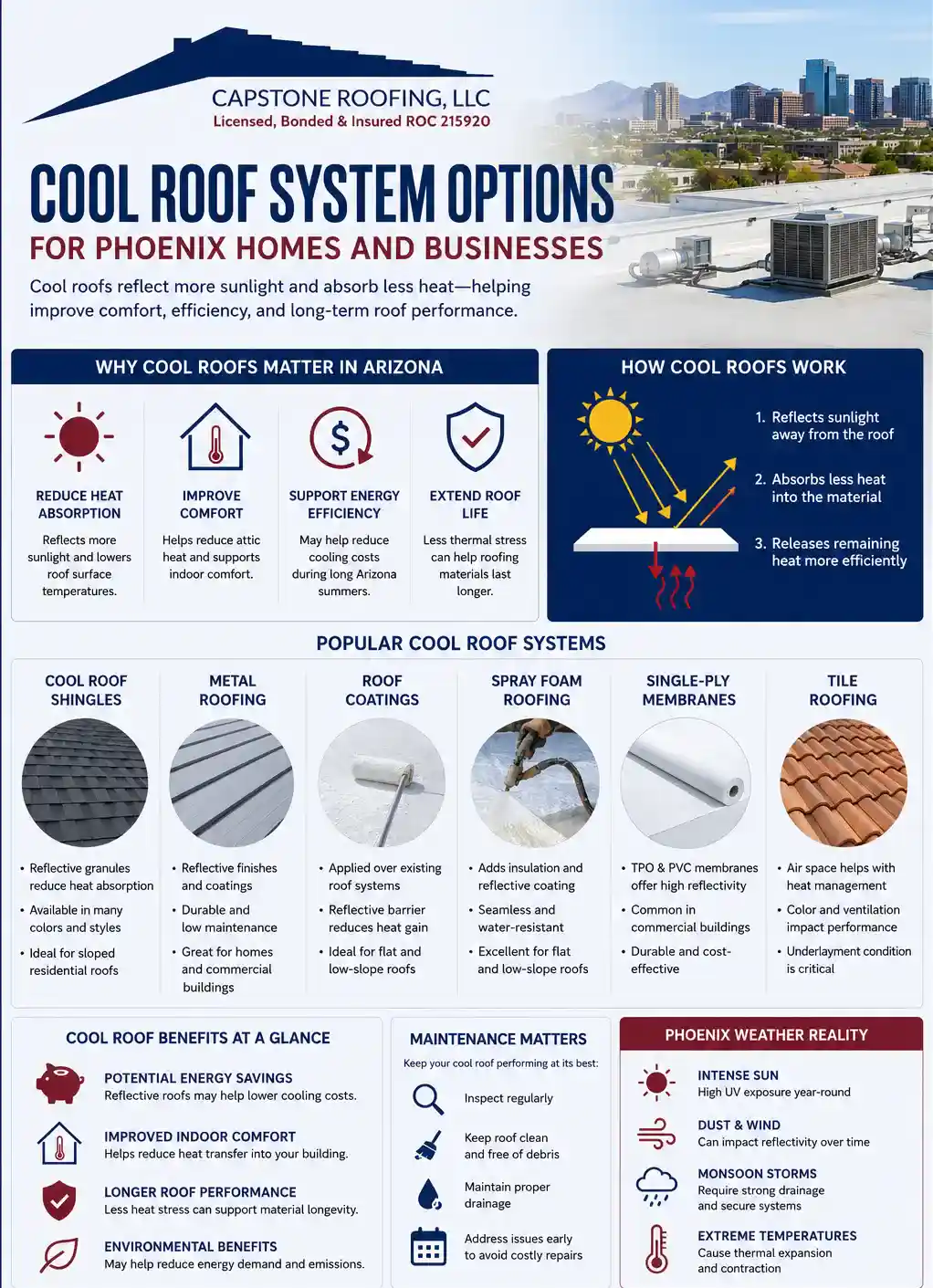
Cool Roof System Options for Phoenix Homes and Businesses
When summer temperatures climb into the triple digits across Phoenix and the surrounding Valley, many property owners start looking for ways to reduce heat gain and improve building efficiency. One roofing term that frequently comes up during this process is the cool roof.
A cool roof is not a single roofing product. Instead, it refers to a roofing system designed to reflect more sunlight and absorb less heat than traditional roofing materials. Cool roof technologies can be found in residential roofing systems, commercial roofing systems, roof coatings, metal roofing, foam roofing, and even certain shingle products.
Many homeowners begin researching cool roofs after exploring broader energy-efficient roofing options that may help address Arizona’s long cooling season and intense summer temperatures.
In Arizona, where roofs experience intense ultraviolet exposure, prolonged summer heat, dust accumulation, and seasonal monsoon storms, understanding how different cool roof systems perform can help homeowners and property managers make more informed decisions.
This guide explains how cool roofs work, the different cool roof systems available for Phoenix-area properties, and the factors that can influence long-term performance in desert environments.
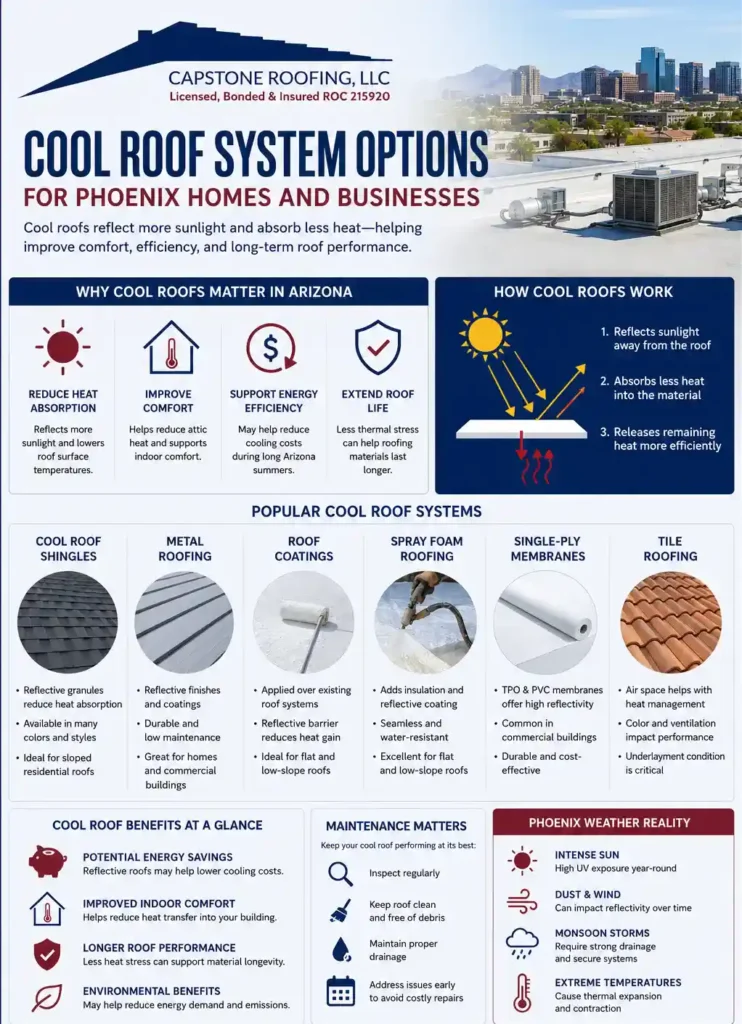
What Is a Cool Roof?
A cool roof is a roofing system designed to reduce roof surface temperatures by reflecting solar radiation and releasing absorbed heat more efficiently than conventional roofing materials.
Two primary characteristics influence cool roof performance:
- Solar Reflectance – the ability of a roof surface to reflect sunlight away from the building.
- Thermal Emittance – the ability of a roofing material to release absorbed heat.
Roof surfaces exposed to direct Arizona sunlight can become significantly hotter than the surrounding air temperature. Materials with higher reflectivity typically remain cooler than darker, less reflective surfaces.
However, roof color alone does not determine whether a roof qualifies as a cool roof. Material composition, coatings, surface treatments, and long-term maintenance all play important roles.
The U.S. Department of Energy’s Cool Roof Guide provides additional information on how reflective roofing systems influence building performance in warm climates.
Why Cool Roofs Matter in Phoenix
The Valley presents unique environmental conditions that influence roofing performance throughout the year.
Unlike regions with short summers and mild winters, Phoenix experiences a long cooling season. Roof surfaces are exposed to intense sunlight for much of the year, creating conditions where solar heat gain can become a significant consideration.
Common Arizona roofing challenges include:
- Extreme UV exposure
- Extended periods of high temperatures
- Thermal expansion and contraction
- Dust and airborne debris accumulation
- Monsoon-driven rain and wind
- Roof surface aging caused by prolonged heat exposure
Because roofing systems sit directly between the building and the sun, roof material selection can influence overall building comfort, attic temperatures, and HVAC workloads. Property owners looking for additional ways to improve performance can also explore several practical approaches to improving roof energy efficiency.
Many property owners first encounter the term “cool roof” while researching ways to keep indoor temperatures more manageable during Arizona summers. Although cool roofs are often associated with energy performance, they should be viewed as part of a complete roofing strategy that includes ventilation, insulation, drainage management, and long-term maintenance planning.
The roofing systems that perform best in Phoenix are typically those designed specifically for desert conditions rather than simply adapted from roofing approaches used in cooler climates.
How Cool Roof Technology Works
When sunlight strikes a roof surface, three things happen:
- A portion of the sunlight is reflected away.
- A portion is absorbed into the roofing material.
- A portion is emitted back into the atmosphere as heat.
Traditional dark roofing materials often absorb more solar energy than highly reflective surfaces.
Cool roof technologies seek to increase reflectivity while improving the roof’s ability to release absorbed heat.
This does not mean the roof becomes cold. Rather, the roof surface generally remains cooler than comparable conventional roofing systems under similar conditions.
The degree of improvement varies based on:
- Roof type
- Roof slope
- Material color
- Roof age
- Dust accumulation
- Maintenance practices
- Surrounding shade conditions
Modern cool roof systems are designed using advanced pigments, coatings, and material technologies that help improve solar reflectance without requiring every roof to be bright white. This allows homeowners and building owners to choose products that fit both performance goals and aesthetic preferences.
Are Cool Roofs Worth It in Phoenix?
This is one of the most common questions homeowners and commercial property owners ask when researching roofing systems.
The answer depends on the building, the existing roof assembly, and the owner’s goals.
In Phoenix, cool roof systems can be appealing because buildings are exposed to prolonged periods of sunlight throughout much of the year. The ability to reflect solar radiation may help reduce roof surface temperatures and support broader energy-efficiency objectives.
However, a cool roof should not be evaluated solely based on potential energy performance. Roof durability, maintenance requirements, compatibility with the building structure, drainage performance, and long-term serviceability all matter.
For example, a highly reflective roofing system that is not maintained properly may lose some of its performance benefits as dust and debris accumulate. Likewise, a roofing system with excellent reflectivity may still experience problems if flashing details, ventilation systems, or drainage pathways are neglected.
Many Phoenix-area property owners find that cool roof technologies make the most sense when incorporated into a comprehensive roofing strategy that addresses both heat management and long-term roof health.
For homeowners planning a future roof replacement, cool roof materials may simply become one of several factors considered alongside appearance, maintenance requirements, and overall roof design.
Cool Roof Shingles
Many homeowners are surprised to learn that cool roof technology is available for sloped residential roofs.
Modern cool roof shingles use specially engineered granules designed to reflect more solar energy while maintaining traditional architectural appearances.
Unlike older reflective roofing systems that were often limited to bright white finishes, today’s cool roof shingles are available in a variety of colors and styles.
Advantages of Cool Roof Shingles
- Compatible with many residential roof designs
- Available in multiple colors
- May help reduce roof surface temperatures
- Can support broader energy-efficiency goals
Considerations
- Performance varies by product.
- Dust accumulation may affect reflectivity over time.
- Ventilation remains important regardless of shingle selection.
Homeowners evaluating roof replacements should view cool roof shingles as one piece of an overall roofing strategy rather than a standalone solution.
Roofing materials alone rarely determine how comfortable a home feels during the summer. Attic insulation, ventilation design, duct placement, and overall roof assembly performance all contribute to the final result.
Energy-Efficient Metal Roofing Systems
Metal roofing systems are commonly discussed when reviewing cool roof technologies.
Many metal roofing products use reflective finishes that help reduce solar heat absorption. Because metal panels can be manufactured with specialized coatings and colors, they offer flexibility for both residential and commercial applications.
Metal roofing is often considered for:
- Residential homes
- Commercial buildings
- Industrial facilities
- Retail properties
- Office buildings
In Arizona, thermal expansion is an important factor for metal roofs. Daily temperature swings can create significant movement within roofing assemblies. Proper detailing around penetrations, flashing systems, and fasteners plays an important role in long-term performance.
Metal roofing should always be evaluated as a complete roofing system rather than solely by the reflectivity of the panel itself.
Many building owners appreciate the longevity and low-maintenance characteristics often associated with metal roofing systems, particularly when paired with high-quality reflective finishes.
Cool Roof Coatings
Reflective roof coatings are among the most commonly discussed cool roof solutions for flat and low-slope roofs.
These coatings are often applied over existing roofing systems when conditions are appropriate.
Coatings work by creating a reflective surface designed to reduce solar heat absorption.
- Acrylic coatings
- Silicone coatings
- Elastomeric coatings
- Reflective roof coatings
For many Phoenix-area commercial buildings, coatings are attractive because they can be incorporated into ongoing roof maintenance strategies.
However, coatings are not appropriate for every roof. Existing roof condition, drainage performance, and substrate condition should all be evaluated before considering a coating application.
For low-slope and built-up roofing systems, reflective coatings are often incorporated into long-term maintenance plans. Our guide covering roof coatings for built-up roofs in Arizona explains how these systems are commonly used throughout the Valley.
One important consideration is that coatings should never be viewed as a universal solution. Proper surface preparation, existing roof conditions, and long-term maintenance planning all play important roles in determining whether a coating system is appropriate.
Spray Foam Roofing as a Cool Roof System
Spray polyurethane foam roofing remains one of the most widely used roofing systems on flat and low-slope buildings throughout Arizona. Because foam roofing combines insulation value with a reflective protective coating, it is frequently included in discussions about cool roof systems.
Unlike many roofing materials that rely primarily on surface reflectivity, foam roofing works as a complete roofing assembly. The foam layer provides insulation while the coating applied over the foam helps protect the system from UV exposure and contributes to the roof’s reflective properties.
For many commercial buildings, warehouses, and some residential structures with flat roofs, foam roofing offers a combination of insulation performance and reflective surface characteristics that align well with Arizona’s climate.
Foam roofing is frequently discussed as part of Arizona’s energy-conscious roofing strategies because it combines insulation value with reflective surface coatings. Property owners comparing options may find it helpful to review whether foam roofs can help reduce energy usage as well as the broader advantages and considerations of foam roofing systems.
Advantages of Foam Roofing
- Continuous insulation layer
- Reflective roof coatings
- Few seams compared to some roofing systems
- Adaptable to many low-slope roofs
- Commonly used throughout Arizona
Important Considerations
- Protective coatings weather over time
- Periodic inspections remain important
- Recoating may be necessary during the roof’s lifespan
- Drainage performance should be monitored regularly
Like all cool roof systems, long-term performance depends heavily on maintenance and periodic inspections rather than installation alone.
Single-Ply Roofing Systems for Commercial Buildings
Single-ply membrane roofing systems are among the most common cool roof solutions used on commercial properties throughout Phoenix and the Valley.
These systems are frequently installed on:
- Office buildings
- Warehouses
- Retail centers
- Educational facilities
- Industrial properties
- Multi-tenant commercial developments
TPO roofing is particularly well known for its reflective characteristics and is often considered during conversations about cool roof performance.
PVC membrane systems may also offer reflective properties depending on the specific roofing assembly.
However, commercial property owners should remember that roofing performance depends on much more than membrane color or reflectivity.
Drainage design, rooftop equipment placement, maintenance access, foot traffic, and long-term repair planning all influence how a roof performs over time.
Businesses comparing commercial roofing materials often evaluate membrane systems alongside other low-slope options. Our comparison of TPO and modified bitumen roofing systems provides additional context for Arizona commercial properties.
The Cool Roof Rating Council (CRRC) provides additional information about roof reflectance testing and rating systems used throughout the roofing industry.
Can Tile Roofs Be Part of a Cool Roof Strategy?
Tile roofs remain one of the most recognizable roofing systems throughout Phoenix, Scottsdale, Mesa, Chandler, Gilbert, and many other Valley communities.
While tile roofs are not always discussed as traditional cool roofs, they can contribute to heat management in several important ways.
Many tile roof assemblies create an air space between the tile and the roof deck. This design can influence heat movement throughout the roofing assembly and help separate the roof surface from the structure below.
Additionally, tile color, tile profile, roof ventilation, and underlayment condition all influence overall roof performance.
In Arizona, roofing professionals frequently find that aging underlayment becomes a more significant concern than the tile itself.
Because the roofing assembly works as a complete system, tile performance is often closely tied to the condition of the underlayment beneath it. Homeowners interested in learning more can review our guides covering tile roofing in Arizona and roof underlayment lifespan in Arizona’s climate.
When evaluating cool roof options, homeowners with tile roofs should consider the entire roof assembly rather than focusing solely on the tile surface.
Understanding Cool Roof Ratings and Performance Measurements
As property owners begin researching cool roof products, they often encounter technical terms such as solar reflectance, thermal emittance, and Solar Reflectance Index (SRI).
While these measurements can appear complicated, they provide useful ways to compare roofing materials.
Solar Reflectance
Solar reflectance measures how much incoming sunlight a roofing surface reflects away from the building.
Generally speaking, higher reflectance values indicate that a roof reflects more solar energy and absorbs less heat.
Thermal Emittance
Thermal emittance measures how effectively a roofing material releases absorbed heat.
A roof may reflect sunlight well, but thermal emittance also affects how quickly absorbed heat dissipates.
Solar Reflectance Index (SRI)
SRI combines reflectance and emittance into a single measurement used to compare roofing products.
While these values can be useful when evaluating materials, they should never be the only factor used when selecting a roofing system.
Building design, roof slope, insulation, ventilation, maintenance requirements, and climate conditions remain equally important considerations.
Why Roof Color Doesn’t Tell the Whole Story
Many people assume that all cool roofs must be bright white.
While white roofing systems often achieve high reflectivity ratings, modern roofing technology has expanded the available options considerably.
Today, cool roof products may be available in:
- Gray tones
- Brown tones
- Tan finishes
- Architectural shingle colors
- Painted metal finishes
- Reflective tile colors
This flexibility allows property owners to pursue cool roof strategies while maintaining architectural consistency and HOA requirements.
How Roof Ventilation Works Alongside Cool Roof Systems
A cool roof should never be evaluated independently from the rest of the roofing assembly.
Ventilation remains one of the most important factors influencing roof performance in Arizona.
Even highly reflective roofing systems can experience challenges if airflow through the attic or roof assembly is inadequate.
Proper ventilation can help:
- Reduce heat buildup
- Improve attic conditions
- Support roofing material longevity
- Manage moisture movement
- Create a more balanced roof system
This is one reason many roofing professionals emphasize complete roof-system planning rather than focusing on a single material or product.
Comparing Popular Cool Roof Systems in Arizona
| Roof System |
Typical Application |
Reflective Potential |
Maintenance Considerations |
| Cool Roof Shingles |
Residential |
Moderate to High |
Granule wear and debris removal |
| Metal Roofing |
Residential & Commercial |
High |
Fasteners and thermal movement |
| Roof Coatings |
Flat Roofs |
High |
Cleaning and recoating cycles |
| Spray Foam Roofing |
Flat & Low-Slope Roofs |
High |
Protective coating maintenance |
| TPO Roofing |
Commercial |
High |
Seam inspections and rooftop traffic |
| Tile Roofing |
Residential |
Varies |
Tile and underlayment condition |
How Dust Impacts Cool Roof Performance
One factor that receives little attention in national roofing discussions is Arizona’s dust environment.
Dust storms, construction activity, and airborne debris can all affect roof surfaces over time.
As dust accumulates, reflective surfaces may not perform exactly as they did when newly installed.
This does not mean cool roofs stop working. Rather, it highlights the importance of routine maintenance.
Property owners should periodically inspect:
- Roof surfaces
- Scuppers
- Drains
- Downspouts
- Valleys
- Drainage pathways
Routine inspections help identify debris buildup before it begins affecting drainage performance. This is one reason regular roof maintenance remains an important part of preserving long-term roof health in Arizona.
How Monsoon Season Affects Cool Roof Systems
Monsoon weather introduces challenges that go beyond temperature management.
Every cool roof system must also function as a weather-resistant roofing system.
Monsoon storms can bring:
- Wind-driven rain
- Flying debris
- Dust accumulation
- Drainage challenges
- Rapid water accumulation
Flat roofs should be inspected regularly to ensure drainage systems remain clear.
Sloped roofs should be evaluated periodically for displaced materials, flashing concerns, and storm-related wear.
Property owners can learn more about seasonal preparation through our guide on preparing a roof for Arizona monsoon season.
Cool Roof Considerations for Property Managers
Property managers often evaluate roofing systems differently than homeowners.
While homeowners may focus on curb appeal, attic temperatures, and long-term maintenance, commercial property managers are often responsible for larger roofing systems, multiple stakeholders, and long-term capital planning.
Commercial roofing decisions frequently involve balancing:
- Building performance
- Maintenance budgets
- Roof accessibility
- Life-cycle planning
- Tenant considerations
- Rooftop equipment requirements
For many commercial properties throughout Phoenix, roofing systems must accommodate HVAC equipment, walk paths, drains, skylights, solar installations, and other rooftop penetrations.
These factors influence not only the initial roofing selection but also how the roof will be maintained over the next decade and beyond.
Questions property managers commonly ask include:
- How accessible is the roof for inspections?
- What maintenance schedule should be expected?
- How will rooftop equipment affect the roof?
- What cleaning requirements may be necessary?
- How will the system perform during monsoon season?
- How does the roof fit into future capital planning?
For commercial properties, cool roof performance should always be evaluated alongside durability, serviceability, and long-term maintenance expectations.
Property managers researching broader commercial roofing options can review our overview of commercial roofing services to understand how different systems are used throughout Arizona.
How Cool Roof Systems Age in Arizona’s Climate
Every roofing system changes over time.
Arizona’s climate creates conditions that can accelerate certain aging processes because roofing materials are exposed to:
- Intense ultraviolet radiation
- Extended summer heat
- Daily thermal expansion and contraction
- Dust accumulation
- Monsoon storms
- Wind-driven debris
As a result, evaluating a roofing system based solely on its appearance when new can be misleading.
Long-term performance depends heavily on maintenance, inspections, drainage management, and material quality.
Some roofing systems may require periodic recoating. Others may require flashing maintenance, sealant replacement, or debris removal throughout their service life.
Understanding how roofing materials age is an important part of making informed roofing decisions.
Homeowners and property managers interested in long-term planning can also review our article discussing how long roofs typically last in Arizona and the environmental factors that influence roof longevity.
The most successful roofing systems are often those supported by a consistent maintenance plan rather than those that are simply installed and forgotten.
Building a Complete Energy-Efficient Roofing Strategy
A cool roof can be an important component of an energy-efficient building strategy, but it is rarely the only factor.
Many of the most effective roofing plans combine multiple elements working together:
- Appropriate roofing materials
- Adequate insulation
- Proper attic ventilation
- Effective drainage design
- Routine maintenance
- Periodic inspections
- Long-term repair planning
In many cases, cool roofs perform best when incorporated into a broader roofing plan that includes ventilation, insulation, maintenance, and appropriate material selection. Homeowners researching options can also review our overview of roofing materials commonly used in Arizona.
Likewise, understanding how ventilation affects overall roof performance can be just as important as selecting a reflective roofing surface.
Heat management, moisture management, drainage performance, and structural compatibility all contribute to the success of a roofing system.
Whether the goal is residential comfort, commercial efficiency, or long-term roof durability, the best results are usually achieved when the entire roofing assembly is considered rather than focusing on a single material or product category.
Frequently Asked Questions About Cool Roofs in Arizona
What is a cool roof?
A cool roof is a roofing system designed to reflect more sunlight and absorb less heat than conventional roofing materials. Cool roof technologies may be found in shingles, metal roofing, coatings, foam roofing systems, and commercial roofing membranes.
Do cool roofs work in Phoenix?
Phoenix’s long cooling season and intense sun exposure make cool roof technologies a common consideration for homeowners and commercial property owners. Performance varies depending on the roofing system, maintenance practices, and overall building design.
Are cool roof shingles worth considering?
Many homeowners choose cool roof shingles because they offer reflective properties while maintaining the appearance of traditional residential roofing materials.
Can metal roofing be considered a cool roof?
Many metal roofing systems utilize reflective finishes and coatings that may contribute to cool roof performance.
Are cool roofs only available in white?
No. Modern cool roof products are available in a variety of colors and finishes, including many options designed to complement residential architecture.
Do cool roof coatings work on flat roofs?
Reflective roof coatings are commonly used on flat and low-slope roofs when conditions are appropriate and the underlying roofing system is suitable for coating applications.
Can a foam roof be considered a cool roof?
Many foam roofing systems include reflective coatings and are frequently discussed as part of cool roof strategies in Arizona.
Do cool roofs eliminate attic heat?
No. While cool roofs may help reduce roof surface temperatures, attic conditions are also influenced by insulation, ventilation, building design, and other factors.
Can dust reduce cool roof performance?
Dust accumulation may affect surface reflectivity over time, which is why regular maintenance and roof inspections are important.
How often should a cool roof be inspected?
Inspection schedules vary by roofing system, building type, and environmental conditions. Many property owners schedule inspections after major monsoon events and as part of routine maintenance planning.
Are cool roofs only for commercial buildings?
No. Cool roof technologies are available for both residential and commercial roofing systems.
What is the best cool roof system for Arizona?
The best roofing system depends on the building design, roof slope, maintenance expectations, performance goals, and existing roofing assembly. There is no single solution that is ideal for every property.
Final Thoughts
Cool roof systems continue to attract attention throughout Phoenix and the Valley because they offer practical ways to address one of Arizona’s most persistent environmental challenges: heat.
Whether the roof involves reflective shingles, metal panels, roof coatings, spray foam, tile assemblies, or single-ply membranes, understanding how these systems function can help property owners make more informed decisions.
Arizona’s climate introduces factors that do not always receive attention in national roofing discussions. Dust accumulation, monsoon weather, UV exposure, thermal movement, drainage performance, and long-term maintenance all influence how a roof performs over time.
For that reason, the best cool roof strategy is rarely determined by reflectivity alone. Long-term performance depends on selecting a roofing system that matches the building’s design, maintenance expectations, and environmental conditions.
Whether you’re evaluating a residential roof replacement or researching solutions for a commercial property, understanding the available systems is the first step toward making an informed decision. Additional information about available residential and commercial roofing solutions can be found within our roofing services overview and our page covering commercial roofing services.
When viewed as part of a complete roofing system, cool roof technologies can play an important role in helping Phoenix-area homes and businesses navigate the realities of desert heat while supporting long-term roof performance and maintenance planning.
published on Friday, June 19th, 2026