Everything You Need to Know About Built-Up Roofing

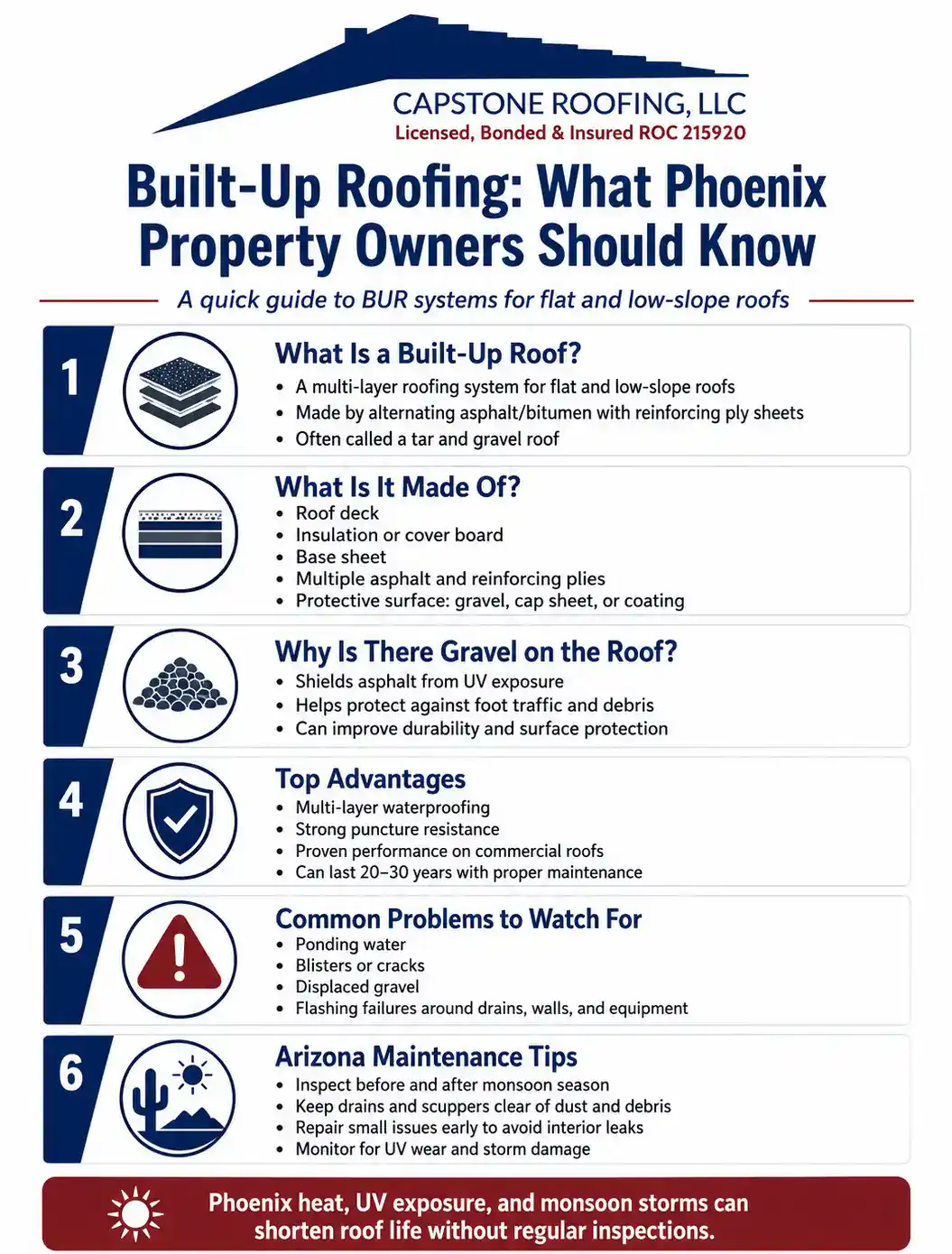
What is a built-up roof, and why are these roofing systems still found on commercial buildings throughout Phoenix? A built-up roof is a multi-layer roofing system designed for flat and low-slope surfaces. Instead of relying on one sheet of roofing material, contractors install alternating layers of asphalt and reinforced roofing fabric to create a thick, continuous waterproof membrane.
Built-up roofing is commonly abbreviated as BUR. It is also frequently called a tar and gravel roof because many traditional systems are finished with a flood coat of asphalt covered by gravel or mineral aggregate. Although newer roofing options such as TPO, PVC, modified bitumen, and spray polyurethane foam have become more common, built-up roofing continues to provide dependable protection for many commercial and residential flat roofs.
The Asphalt Roofing Manufacturers Association describes built-up roofing as a system made from multiple layers of asphalt alternated with reinforcing ply sheets. These layers are installed over the roof deck, insulation, or an approved cover board to form a water-resistant barrier. Property owners can review additional technical information from the Asphalt Roofing Manufacturers Association’s built-up roofing guide.
For Phoenix property owners, built-up roofing presents both advantages and challenges. Its multiple layers offer dependable waterproofing, puncture resistance, and long-term durability. However, Arizona’s extreme heat, ultraviolet exposure, dust, monsoon storms, and rapid temperature changes can accelerate surface wear when the roof is not maintained properly.
This guide explains what a built-up roof system is made of, how it is installed, why gravel is placed on flat roofs, how long BUR systems last, common repair needs, maintenance requirements, costs, benefits, disadvantages, and how built-up roofing compares with other commercial roofing systems.
What Is a Built-Up Roof?
A built-up roof is a flat or low-slope roofing system constructed from several layers of bitumen and reinforcing fabric. The word “built-up” refers to the installation process. Contractors build the waterproof membrane directly on the roof by installing one layer at a time.
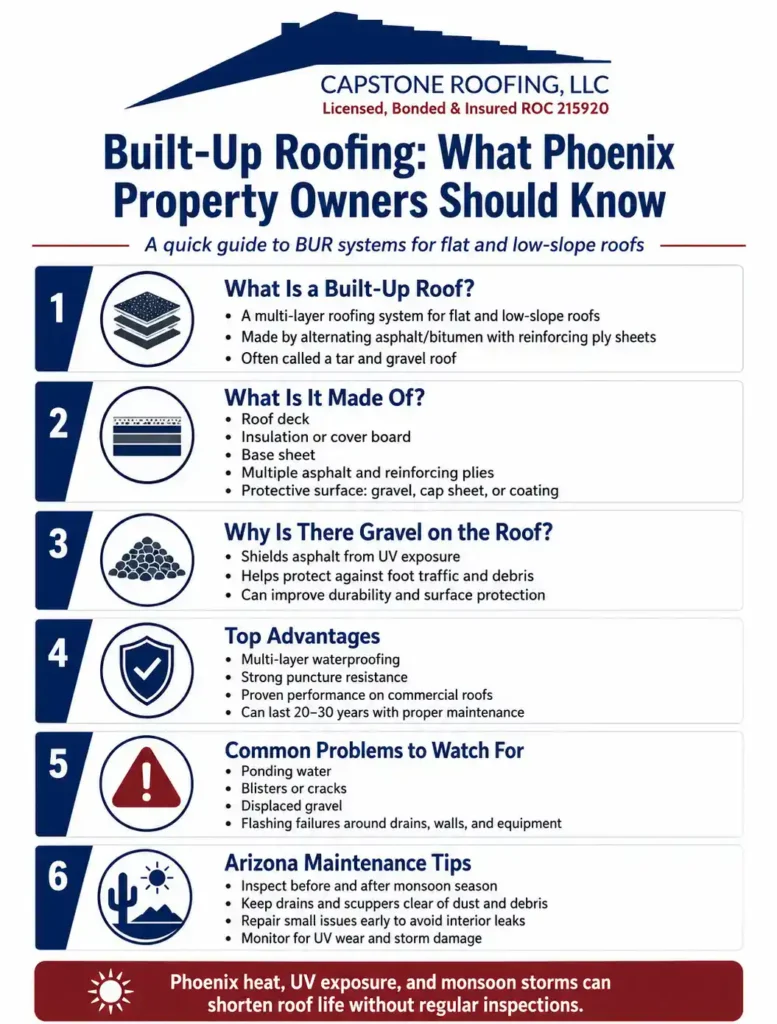
A typical built-up roofing system includes:
- A structural roof deck
- A vapor retarder when required
- Roof insulation or a cover board
- A base sheet
- Multiple layers of asphalt or adhesive
- Reinforcing roofing felts or ply sheets
- A protective surface made from gravel, mineral granules, a cap sheet, or a reflective coating
The alternating layers are sometimes called plies. A three-ply system contains three reinforcing sheets, while four-ply and five-ply systems contain additional layers. Each ply adds redundancy to the roof. When the outer surface is damaged, the layers underneath may continue preventing water from entering the building until repairs can be completed.
Built-up roofing has been used on flat roofs for more than a century. Its long history is one reason many facility managers and commercial property owners remain comfortable with the system. Contractors understand how it performs, how it ages, and how damaged sections can be repaired.
Built-up roofs are most commonly installed on commercial properties, warehouses, industrial buildings, schools, apartment buildings, office complexes, retail centers, and other structures with large low-slope roof areas. They may also be used on residential additions, patios, garages, and homes with flat roofing sections.
Property owners considering a BUR system can find additional information about locally available built-up roofing systems for Phoenix properties, including installation and repair considerations for Arizona buildings.
What Is a Built-Up Roof Made Of?
A built-up roof is made from several components that work together as a complete roofing assembly. The exact materials vary by manufacturer, building design, roof slope, fire rating, energy requirements, and installation method.
Roof Deck
The roof deck is the structural surface supporting the roofing assembly. Commercial roof decks may be constructed from steel, concrete, wood, lightweight insulating concrete, or other approved materials. The deck must be structurally sound, properly secured, and capable of supporting the weight of the roofing materials.
Built-up roofs can be considerably heavier than single-ply systems. Before installing a new BUR assembly, the building structure may need to be evaluated to confirm that it can support the insulation, asphalt, reinforcing sheets, and surface aggregate.
Vapor Retarder
A vapor retarder may be included when moisture movement from inside the building could affect the insulation or roofing membrane. Vapor control requirements depend on the building’s use, interior humidity, roof design, and local construction requirements.
Buildings containing kitchens, manufacturing areas, laundry facilities, pools, or other moisture-producing operations may require special consideration. A roofing contractor, designer, or engineer should evaluate whether a vapor retarder is appropriate.
Roof Insulation
Insulation helps reduce heat transfer through the roof assembly. Common commercial roofing insulation materials include polyisocyanurate, expanded polystyrene, extruded polystyrene, and mineral wool. Tapered insulation may also be used to create positive drainage toward roof drains, gutters, scuppers, or collection points.
Insulation is especially important in Phoenix, where roof surfaces are exposed to prolonged summer heat. The roof membrane protects the building from water, while the insulation helps reduce the amount of outdoor heat entering conditioned interior spaces.
Cover Board
A cover board may be installed over the insulation to create a stable surface for the roofing membrane. It can also improve puncture resistance, dimensional stability, fire performance, and protection around areas with regular maintenance traffic.
Cover boards are useful on commercial buildings where HVAC technicians, electricians, solar contractors, and other service personnel may need roof access.
Base Sheet
The base sheet forms the first membrane layer. Depending on the roofing specification, it may be mechanically fastened, adhered, or installed using another approved method. The base sheet creates a foundation for the asphalt and reinforcing plies installed above it.
Bitumen
Bitumen is the waterproofing material that bonds the reinforcing layers together. Traditional systems use hot asphalt applied with roofing mops or mechanical spreaders. Other systems use cold-process adhesives that can be applied without heating asphalt in a kettle.
Coal-tar pitch was historically used in some built-up roof assemblies, but asphalt-based BUR systems are far more common today. Property owners should not assume that every gravel-covered roof contains coal tar. Roof samples or construction records may be needed to identify the existing materials accurately.
Reinforcing Ply Sheets
Ply sheets are reinforcing fabrics installed between layers of asphalt or adhesive. Modern ply sheets are commonly manufactured with fiberglass reinforcement. The sheets strengthen the membrane and help distribute movement and stress throughout the system.
Several ply sheets are overlapped and embedded into the bitumen. The result is a continuous membrane without the long exposed seams found on some single-ply roof systems.
Protective Surfacing
The final surface protects the asphalt from sunlight, heat, weather, foot traffic, and physical damage. Common surfacing options include:
- Gravel or crushed stone embedded into a flood coat of asphalt
- Mineral-surfaced cap sheets
- Aluminum coatings
- White elastomeric roof coatings
- Reflective aggregate
- Other manufacturer-approved protective surfaces
The surfacing choice can significantly affect roof temperature, maintenance needs, drainage visibility, and energy performance.
How Is a Built-Up Roofing System Installed?
Built-up roof installation involves more than spreading tar and gravel across a roof. Each component must be installed in the correct sequence, with proper adhesion, fastening, flashing, drainage, and surface protection.
The general installation process includes the following stages.
1. Inspecting and Preparing the Roof Deck
The existing roof materials may need to be removed before the deck can be evaluated. Contractors look for deteriorated decking, trapped moisture, corrosion, damaged wood, loose fasteners, uneven surfaces, and other conditions that could affect the new roof.
Wet insulation and damaged decking should be addressed before the new assembly is installed. Covering moisture inside the roof system can lead to blistering, deterioration, odor, loss of insulation performance, and recurring leaks.
2. Installing Insulation and Drainage Components
Insulation boards are placed over the roof deck and secured according to the roofing specification. Tapered insulation may be installed to improve drainage on roofs that are too flat or have recurring ponding areas.
Roof drains, scuppers, gutters, overflow drains, and edge details must be incorporated into the design. A waterproof membrane cannot compensate indefinitely for poor drainage.
3. Installing the Base Sheet
The base sheet is installed over the prepared substrate. It may be mechanically attached or adhered depending on the roof design and manufacturer requirements.
4. Applying Asphalt or Cold Adhesive
Roofing asphalt or cold-process adhesive is applied in a controlled layer. The quantity and temperature must be appropriate for the chosen material. Asphalt that is overheated, allowed to cool too much, or spread unevenly can affect adhesion and long-term performance.
5. Embedding the Ply Sheets
Reinforcing sheets are rolled into the asphalt or adhesive. Additional layers are installed until the roof reaches the specified number of plies. The sheets must be positioned with proper overlaps and without wrinkles, voids, fishmouths, or trapped air.
GAF provides a detailed overview of the alternating membrane construction in its explanation of how built-up roof systems are assembled.
6. Installing Flashing and Penetration Details
Flashings are installed around walls, curbs, roof drains, vents, HVAC equipment, pipes, skylights, parapets, and other roof penetrations. Many leaks blamed on the roof field actually begin at transitions, penetrations, or deteriorated flashing details.
7. Applying the Finished Surface
The roof may be finished with a mineral-surfaced cap sheet, reflective coating, or a flood coat of asphalt covered with aggregate. Gravel must be distributed evenly so the asphalt remains protected.
Once installation is complete, the roof should be inspected for proper coverage, flashing continuity, drainage, surface defects, and construction debris.
What Is a Built-Up Tar and Gravel Roof?
A built-up tar and gravel roof is a BUR system finished with a layer of stone aggregate. The term “tar and gravel” is commonly used even when the waterproofing material is asphalt rather than actual coal tar.
The roof membrane is created by alternating layers of asphalt and reinforcing fabric. Contractors then apply a final flood coat of asphalt and embed gravel into the surface while the material is still hot or tacky.
The gravel is not decorative. It performs several important functions:
- Protects asphalt from ultraviolet radiation
- Reduces direct exposure to extreme heat
- Helps resist surface damage from hail and debris
- Provides protection from limited maintenance traffic
- Improves fire performance in approved assemblies
- Helps hold some roofing components in place
- Slows deterioration of the asphalt surface
Gravel-covered BUR systems are especially recognizable on older commercial buildings throughout Phoenix. However, loose gravel can also make routine inspections more difficult because the membrane is hidden beneath the surface layer.
Why Do They Put Rocks on Flat Roofs?
One of the most common questions about built-up roofing is why buildings have rocks or gravel on the roof. The stones primarily protect the asphalt membrane underneath.
Unprotected asphalt is vulnerable to ultraviolet radiation. Over time, constant sunlight can dry the surface, accelerate oxidation, and contribute to cracking. Gravel blocks much of that direct exposure and helps the asphalt retain its waterproofing properties longer.
Aggregate also protects against physical damage. Phoenix roofs may be exposed to windblown debris, maintenance tools, HVAC service traffic, birds, falling branches, and storm-related impacts. The gravel absorbs some of that contact before it reaches the roofing plies.
Light-colored aggregate can reflect more solar energy than exposed black asphalt. However, gravel alone should not automatically be considered a high-performance cool roof. Reflectance depends on the aggregate color, coverage, cleanliness, and roofing assembly.
The U.S. Department of Energy explains that reflective roof surfaces can reduce roof temperature and decrease heat transferred into a building. Property owners evaluating energy improvements can review the department’s information about cool roofs and reflective roofing surfaces.
Stones may also be used as ballast on certain roof systems. A ballasted roof relies on the weight of aggregate or pavers to help secure a membrane. However, not every roof with rocks is a ballasted roof. On a traditional built-up roof, the gravel is usually embedded into the asphalt surfacing rather than serving as the primary attachment method.
What Is a Ballasted Roof?
A ballasted roof uses gravel, stone, or concrete pavers to hold a roofing membrane in place. Instead of fully adhering the membrane across the entire roof deck, installers loosely lay the membrane and secure critical areas such as roof edges and penetrations. The weight of the ballast helps resist movement and wind uplift.
Although ballasted roofs and built-up roofs may both contain gravel, they are not the same system.
| Roof System |
Primary Waterproofing Method |
Purpose of the Gravel |
| Built-up roofing |
Multiple bonded layers of asphalt and reinforcing fabric |
Protects the asphalt surface and may add weight |
| Ballasted membrane roof |
Loose-laid or partially attached membrane |
Provides the primary weight holding the membrane down |
Ballasted roofs can be faster to install and may protect the membrane from sunlight. However, they add significant weight, can make inspections more difficult, and require careful edge and wind-uplift design. Gravel may also shift during severe weather or gather around drains.
Before adding ballast to any roof, the building structure must be evaluated for the additional load.
Types of Built-Up Roofing Systems
Built-up roofing systems can be categorized by their application method and finished surface. The most appropriate system depends on the property, occupancy, access, roof design, and project requirements.
Hot-Applied Built-Up Roofing
Hot-applied BUR is the traditional installation method. Asphalt is heated in a kettle and transported to the roof, where it is spread between layers of reinforcing felt.
This method creates strong adhesion and has a long history of dependable performance. However, it requires experienced crews, temperature control, safety precautions, and careful planning around occupied buildings. Odors and fumes can also affect tenants, employees, customers, or nearby properties.
Cold-Applied Built-Up Roofing
Cold-applied BUR uses adhesives that do not require a hot asphalt kettle. The adhesive may be applied with a squeegee, roller, spray equipment, or another manufacturer-approved method.
Cold-process installation can reduce odor, smoke, burn risks, and disruption. It may be suitable for schools, medical facilities, retail buildings, multifamily properties, and other occupied locations where hot asphalt would be difficult to manage.
Cold-applied systems still require suitable weather and substrate conditions. Contractors must follow temperature, curing, storage, and application requirements for the adhesive being used.
Gravel-Surfaced Built-Up Roofing
This traditional system is finished with a flood coat of asphalt and embedded gravel. It offers good surface protection and puncture resistance, but the loose aggregate can conceal membrane damage and collect near drainage areas.
Mineral-Surfaced Cap Sheet Systems
Instead of loose gravel, some built-up roofs are finished with a mineral-surfaced cap sheet. The granules are factory-applied to the sheet, creating a more uniform surface that can be easier to inspect and maintain.
Smooth-Surfaced Built-Up Roofing
A smooth BUR system does not use loose aggregate as its final surface. It may be protected with an aluminum coating, elastomeric roof coating, or another approved surfacing product.
Smooth surfaces can make it easier to identify cracks, blisters, and drainage problems. They may also provide a better substrate for reflective coatings, provided the existing roof is dry, stable, and suitable for restoration.
Property owners considering restoration can review the differences between replacement and roof coatings for built-up roofs in Arizona.
How Many Layers Does a Built-Up Roof Have?
Most built-up roofs contain three, four, or five reinforcing plies, although the complete roof assembly includes additional components such as insulation, base sheets, bitumen, flashings, and surface protection.
The number of plies influences the membrane’s thickness, redundancy, weight, installation time, and cost.
- Three-ply BUR: Often used when a lighter or more economical system is appropriate.
- Four-ply BUR: Adds another reinforcing layer for additional protection and durability.
- Five-ply BUR: Provides greater redundancy but also increases material, labor, and structural load.
More layers do not automatically guarantee a longer-lasting roof. Installation quality, drainage, flashing design, insulation condition, surface protection, roof traffic, and maintenance can be just as important as the number of plies.
What Are the Advantages of Built-Up Roofing?
Built-up roofing remains a practical option because it combines multiple layers of waterproofing with a durable protective surface.
Multiple Layers of Waterproof Protection
The primary advantage of BUR is redundancy. A single puncture or surface defect may not immediately pass through every reinforcing layer. This can provide additional time to identify and repair damage before water reaches the roof deck.
Dependable Performance on Flat Roofs
Built-up roofing was developed specifically for low-slope applications. When the roof is properly designed and drained, the continuous membrane provides dependable protection across large commercial roof areas.
Resistance to Punctures and Foot Traffic
The thick membrane and protective surface can withstand more routine contact than some exposed single-ply membranes. BUR may be useful on buildings with frequent HVAC maintenance, rooftop equipment, or controlled service traffic.
Walk pads should still be installed around access points and mechanical equipment. No roofing membrane should be treated as a general walking surface.
Fire-Resistant Assemblies
Many built-up roofing assemblies can achieve strong fire classifications when installed as tested systems. Fire performance depends on the deck, insulation, membrane, surface materials, and complete assembly—not merely the presence of gravel.
Proven Repair Methods
Roofing contractors have repaired BUR systems for generations. Damaged areas can often be opened, dried, rebuilt with compatible materials, and resurfaced without replacing the entire roof.
Restoration Potential
A structurally sound built-up roof may be a candidate for resurfacing or coating. Restoration can improve reflectivity, cover minor surface deterioration, and extend service life when moisture has not spread throughout the assembly.
Protection From Arizona Sunlight
Gravel, mineral surfaces, and reflective coatings protect the asphalt from direct UV exposure. This surface protection is particularly valuable in Phoenix, where the roof experiences prolonged sunlight and extreme summer temperatures.
What Are the Disadvantages of Built-Up Roofing?
Built-up roofing is durable, but it is not the best system for every property.
The System Is Heavy
Multiple layers of asphalt, reinforcing fabric, and gravel can add substantial weight. The roof deck and building structure must be capable of supporting the complete system, including water that may temporarily accumulate during a storm.
Installation Can Be Disruptive
Hot asphalt installation produces odor and requires equipment, staging space, safety planning, and experienced labor. This can make traditional BUR difficult to install near building entrances, air intakes, occupied areas, or neighboring businesses.
Gravel Can Hide Damage
Loose aggregate may conceal cracks, blisters, open seams, and punctures. Contractors often need to move the gravel before they can inspect the underlying membrane.
Leaks Can Be Difficult to Trace
Water may enter at one location and travel between layers or along the roof deck before appearing inside. The interior stain may not be directly below the exterior opening.
Professional roof leak detection can help identify the entry point, evaluate moisture spread, and determine whether the problem is isolated or part of a larger failure.
Ponding Water Can Accelerate Deterioration
Built-up roofs are water-resistant, but they should not be expected to hold standing water indefinitely. Ponding can collect dirt, increase structural load, accelerate surface deterioration, and expose weak flashings.
Repair Materials Must Be Compatible
Applying the wrong coating, cement, primer, or membrane over an existing roof can cause adhesion failure or trap moisture. The original roof material should be identified before repairs or restoration begin.
Newer Systems May Be Faster to Install
TPO, PVC, modified bitumen, and foam roofing can offer faster installation or lighter assemblies. The best choice depends on the building, budget, energy goals, rooftop use, drainage, and expected service life.
How Long Does a Built-Up Roof Last?
A properly installed and maintained built-up roof commonly lasts approximately 20 to 30 years. Some systems may provide service beyond that range, while roofs with poor drainage, trapped moisture, weak flashings, heavy traffic, or neglected maintenance may fail sooner.
Factors affecting built-up roof lifespan include:
- The number and quality of reinforcing plies
- Installation workmanship
- Roof slope and drainage
- Insulation and deck condition
- Quality of flashing details
- Arizona UV and heat exposure
- Monsoon wind and debris impacts
- Frequency of roof traffic
- Maintenance history
- Whether leaks are repaired promptly
- Condition of the gravel or protective coating
Roof age alone does not determine whether replacement is necessary. A 25-year-old BUR may remain serviceable if it is dry, well-drained, and properly maintained. A much newer roof may require major work if water has saturated the insulation or repeated repairs have failed.
A commercial roof inspection should evaluate the membrane, flashings, drains, penetrations, edges, repairs, surface coverage, and signs of trapped moisture. Capstone’s guide to the benefits of commercial roof inspections explains why routine evaluations can help identify developing problems before they interrupt building operations.
How Does Phoenix Weather Affect Built-Up Roofing?
Built-up roofing in Phoenix experiences environmental conditions that differ significantly from those in cooler or wetter climates.
Extreme UV Exposure
Ultraviolet radiation breaks down exposed asphalt over time. Gravel, mineral granules, aluminum coatings, and reflective elastomeric coatings help shield the membrane from direct sunlight.
Areas where gravel has moved may deteriorate faster because the asphalt is no longer protected. These bare spots should be evaluated before the surface begins cracking or blistering.
High Roof Temperatures
Dark roofing surfaces absorb solar heat. During Phoenix summers, the surface temperature of an unprotected roof can become much hotter than the surrounding air.
Heat accelerates oxidation and causes roofing materials to expand. After sunset, the roof cools and contracts. Repeated thermal movement places stress on flashings, penetrations, walls, seams, and previous repairs.
Monsoon Wind
Strong wind can move loose aggregate, expose asphalt, damage edge details, and carry debris onto the roof. Windblown branches, signs, tools, and building materials can puncture the membrane.
Heavy Rainfall
Arizona may receive limited annual rainfall, but monsoon storms can release a large amount of water quickly. Drains and scuppers must remain open so the roof can discharge water efficiently.
Commercial property owners should be familiar with common commercial roof problems in Phoenix, including ponding water, drainage blockages, damaged flashing, surface deterioration, and storm-related punctures.
Dust and Debris Accumulation
Dust settles into low areas and around drains. When mixed with rainwater, it can form heavy sediment that slows drainage. Organic debris may also support plant growth in neglected areas.
Reflectivity and Energy Performance
Reflective coatings or light-colored surfaces can reduce solar heat absorption. Property owners evaluating roof restoration may also want to compare other energy-efficient roofing options for Arizona buildings.
How Much Does Built-Up Roofing Cost?
Built-up roofing costs vary significantly, so broad per-square-foot figures should be treated only as preliminary planning ranges. A contractor must inspect the property before providing a dependable estimate.
Major cost factors include:
- Roof size
- Number of plies
- Hot-applied or cold-applied installation
- Type and thickness of insulation
- Tapered insulation requirements
- Existing roof removal
- Deck repairs
- Wet insulation replacement
- Roof access and building height
- HVAC equipment and penetrations
- Parapet wall and flashing conditions
- Drain, scupper, and gutter modifications
- Surface type
- Reflective coating requirements
- Permits and engineering
- Occupied-building restrictions
A roof with a simple open layout will generally be less labor-intensive than a roof containing numerous curbs, vents, pipes, drains, walls, and mechanical systems. Tear-off costs may also increase when several existing roof layers must be removed.
Property owners should be cautious about comparing estimates based solely on total price. One proposal may include new insulation, tapered drainage, metal flashing, deck repairs, and a multi-ply membrane, while another may cover only the visible roof surface.
A complete proposal should identify the roof assembly, attachment method, insulation, number of plies, surfacing, flashing scope, drainage work, tear-off requirements, warranties, exclusions, and procedures for unexpected deck damage.
Common Built-Up Roof Problems
Most built-up roof failures develop gradually. Recognizing the early signs can help property owners schedule repairs before water spreads through the insulation or reaches occupied spaces.
Blisters
Blisters are raised areas caused by air or moisture trapped between roof layers. As the roof heats during the day, trapped vapor expands and pushes against the membrane.
Small stable blisters may be monitored, but cracked or expanding blisters can open the membrane. Walking on a blister may also rupture it.
Cracks and Splits
Cracks can form as asphalt ages and loses flexibility. Larger splits may result from building movement, insulation gaps, thermal stress, or weak attachment.
Bare Asphalt
When gravel moves away from an area, the asphalt becomes exposed to sunlight. Bare areas may dry, crack, and deteriorate faster than the surrounding roof.
Ponding Water
Water remaining on the roof long after a storm may indicate blocked drains, compressed insulation, structural deflection, or inadequate slope.
Deteriorated Flashing
Flashings around walls, equipment curbs, pipes, drains, and roof edges often fail before the main roof field. Open flashing can allow substantial water intrusion even when the surrounding membrane remains intact.
Loose or Missing Aggregate
Wind and foot traffic can displace gravel. Aggregate may accumulate around drains or leave the asphalt exposed.
Open Pitch Pans and Penetrations
Older roofs may contain pitch pans filled with sealant around irregular penetrations. The filler can shrink or crack and must be maintained.
Improper Previous Repairs
Temporary patches made with incompatible sealants, plastic cement, spray foam, or household products may separate from the roof and make later repairs more difficult.
How Is Built-Up Roof Repair Performed?
Built-up roof repair begins with determining where water entered and how far moisture has spread. The visible interior leak location may not identify the actual roof opening.
A typical repair process may include:
- Inspecting the roof surface, flashings, drains, and penetrations
- Moving gravel away from the suspected area
- Removing loose, cracked, blistered, or water-damaged materials
- Allowing the area to dry when appropriate
- Replacing damaged insulation or decking
- Installing compatible reinforcing plies and asphalt or adhesive
- Feathering the repair into the existing membrane
- Restoring the gravel, cap sheet, or coating
- Checking surrounding areas for related damage
Small surface cracks may be repairable without removing a large section of roofing. However, widespread moisture, deteriorated insulation, repeated leaks, or extensive splitting may require a larger repair or roof replacement.
Effective built-up roof repair should restore the layered design rather than placing a thin patch over unstable materials.
Can a Built-Up Roof Be Coated?
Many built-up roofs can be coated, but the roof must first be evaluated for moisture, adhesion, drainage, structural condition, and compatibility.
A coating may be appropriate when:
- The membrane remains securely attached
- The insulation is substantially dry
- Leaks and damaged areas can be repaired
- The surface can be cleaned and prepared
- Drainage is functioning properly
- The selected coating is compatible with the BUR surface
A coating should not be used to hide saturated insulation, active leaks, rotten decking, unstable blisters, or widespread membrane separation. Coating over wet materials can trap moisture and delay necessary repairs.
Reflective coatings can improve surface protection and reduce solar heat absorption. Depending on the product, the roof may require pressure washing, primer, reinforcing fabric at flashings, crack repairs, and multiple coating applications.
A property owner comparing restoration and replacement should request documentation of moisture testing, repair areas, coating thickness, product requirements, and warranty terms.
Built-Up Roofing vs. Modified Bitumen
Built-up roofing and modified bitumen are both asphalt-based systems, but they are manufactured and installed differently.
| Feature |
Built-Up Roofing |
Modified Bitumen |
| Membrane construction |
Created on the roof from alternating asphalt and reinforcing plies |
Factory-manufactured asphalt membrane sheets |
| Typical number of layers |
Multiple reinforcing plies |
Commonly installed as one or two membrane layers |
| Surface |
Gravel, cap sheet, or coating |
Mineral granules, coating, or smooth membrane |
| Installation |
Hot asphalt or cold adhesive |
Torch-applied, self-adhered, hot asphalt, or cold adhesive |
| Inspection |
Loose gravel may conceal defects |
Exposed sheets may be easier to inspect |
Modified bitumen contains polymers that improve asphalt flexibility and performance. It may be selected for smaller commercial roofs, additions, complex flashing areas, and properties where a factory-manufactured sheet is preferred.
For a closer look at the material, read Capstone’s guide explaining what a modified bitumen roof is.
Built-Up Roofing vs. TPO
TPO is a single-ply thermoplastic membrane, while built-up roofing uses several layers of asphalt and reinforcing fabric.
TPO is generally lighter and can be installed more quickly. White TPO membranes are also naturally reflective. Seams are joined with hot-air welding, creating a continuous surface when installed correctly.
BUR offers greater membrane thickness and redundancy. It may provide better puncture protection in areas with frequent rooftop service activity, although its weight and installation requirements can be disadvantages.
The right system depends on the roof deck, building structure, rooftop traffic, energy goals, drainage, installation environment, and budget. Arizona business owners comparing asphalt and single-ply systems can review TPO versus modified bitumen roofing for additional context.
Built-Up Roofing vs. Spray Foam Roofing
Spray polyurethane foam roofing is created by applying liquid components that expand into a seamless insulating layer. A protective elastomeric coating is then applied over the foam.
Foam roofing is lightweight and can add insulation while conforming around penetrations. It can also be shaped to improve drainage in some roof areas. However, the coating must be maintained because exposed foam can be damaged by sunlight and moisture.
Built-up roofing is heavier and does not provide the same monolithic insulation layer, but its multiple reinforced plies offer strong puncture resistance and a long performance history.
Neither system is universally better. The existing roof, deck condition, drainage, rooftop equipment, structural load, and maintenance expectations should guide the decision.
Is Built-Up Roofing Still a Good Choice?
Built-up roofing is still a good choice for certain flat and low-slope buildings. It is especially suitable when the property needs a durable multi-ply membrane, proven waterproofing, and resistance to controlled roof traffic.
BUR may be worth considering when:
- The building can support the roof’s weight
- The roof contains a large open low-slope area
- Multiple waterproofing layers are preferred
- The property receives regular rooftop maintenance traffic
- The installation environment can accommodate the selected application method
- The owner wants a system with established repair procedures
Another system may be more appropriate when:
- The building structure requires a lightweight roof
- Hot asphalt odor cannot be tolerated
- Fast installation is a major priority
- A highly reflective white membrane is preferred
- The roof contains extensive complex penetrations
- The property would benefit from additional foam insulation
A professional evaluation should compare complete roof assemblies rather than individual membrane products. Capstone’s overview of commercial roofing systems explains several flat-roof options used on Arizona properties.
How to Maintain a Built-Up Roof in Arizona
Maintenance does not make a roof last forever, but it can reduce preventable damage and help property owners plan repairs before leaks disrupt the building.
Schedule Regular Inspections
Built-up roofs should generally be inspected at least annually and after major storms. Commercial properties with frequent rooftop activity, older roofing materials, or recurring drainage problems may benefit from more frequent evaluations.
Keep Drains and Scuppers Clear
Remove leaves, plastic, roofing debris, sediment, and gravel from drainage areas. Drains should have secure strainers, and overflow drainage should remain unobstructed.
Redistribute Displaced Gravel
Bare asphalt should not remain exposed. Aggregate should be redistributed or replaced using materials compatible with the existing roof.
Limit Unnecessary Roof Traffic
Access should be restricted to authorized personnel. Walk pads can help protect routes between roof access points and mechanical equipment.
Document Rooftop Work
HVAC, electrical, solar, plumbing, and communications contractors can accidentally puncture or contaminate roofing materials. Property managers should document who accessed the roof and inspect work areas afterward.
Address Small Defects Promptly
Open flashing, cracked sealant, missing aggregate, and minor punctures are usually easier to repair before water spreads into the insulation.
Monitor Interior Warning Signs
Ceiling stains, musty odors, wet insulation, bubbling paint, and unexplained humidity may indicate a roof leak. Interior symptoms should be investigated even when the roof surface appears normal.
Frequently Asked Questions About Built-Up Roofing
What is a built-up roof system?
A built-up roof system is a flat or low-slope roof made from multiple alternating layers of asphalt and reinforcing fabric. The roof is usually finished with gravel, a mineral-surfaced cap sheet, or a protective coating.
What is a built-up roof made of?
A built-up roof typically includes a roof deck, insulation, a base sheet, several reinforcing ply sheets, asphalt or cold adhesive, flashing materials, and a protective surface such as gravel, mineral granules, or reflective coating.
Is a built-up roof the same as a tar and gravel roof?
Tar and gravel roof is a common name for a gravel-surfaced built-up roof. However, many modern systems use asphalt rather than true coal-tar pitch. Not every built-up roof has gravel because some are finished with cap sheets or coatings.
Why is there gravel on a built-up roof?
Gravel protects the asphalt from ultraviolet exposure, heat, physical damage, and limited foot traffic. It can also improve fire performance and help shield the membrane from windblown debris.
Is every roof with rocks a ballasted roof?
No. Traditional built-up roofs use gravel as protective surfacing embedded in asphalt. A ballasted roof uses the weight of loose stones or pavers as a primary method of holding a membrane in place.
How long does a built-up roof last in Arizona?
Many properly installed and maintained built-up roofs last approximately 20 to 30 years. Arizona heat, UV exposure, drainage, roof traffic, flashing condition, maintenance, and installation quality can shorten or extend that range.
Can a built-up roof be repaired?
Yes. Contractors can remove gravel, cut out damaged materials, replace wet insulation, rebuild the affected plies, and restore the surface. The scope depends on how far moisture or deterioration has spread.
Why is my built-up roof leaking even though it looks fine?
The opening may be hidden under gravel or located at a drain, wall, pipe, curb, or flashing detail. Water can also travel between roof layers before appearing indoors, so the ceiling stain may not be directly below the leak.
Can a built-up roof be coated instead of replaced?
A dry and securely attached built-up roof may be suitable for a compatible roof coating after repairs and surface preparation. Coatings should not be installed over saturated insulation, unstable blisters, active leaks, or severely deteriorated roofing.
How often should a built-up roof be inspected?
Most built-up roofs should be inspected at least once a year and after major wind or monsoon events. Older roofs, heavily trafficked roofs, and buildings with drainage issues may require more frequent inspections.
Can you walk on a built-up roof?
Built-up roofs generally tolerate controlled maintenance traffic better than many thin exposed membranes, but unnecessary walking should still be limited. Walk pads should be used around rooftop equipment and common service routes.
How do I know when a built-up roof needs replacement?
Replacement may be appropriate when the roof has widespread wet insulation, recurring leaks, extensive cracking, deteriorated flashings, unstable blisters, poor adhesion, damaged decking, or repair costs that no longer provide dependable long-term value.
Understanding Your Built-Up Roof Before Making a Decision
Built-up roofing remains one of the most recognizable flat-roof systems in the United States. Its alternating layers of asphalt and reinforcing fabric create a thick membrane with dependable waterproofing and strong puncture resistance. Gravel, cap sheets, and reflective coatings protect the system from sunlight, weather, and physical damage.
For Phoenix property owners, the most important considerations are roof temperature, UV exposure, drainage, displaced gravel, flashing condition, rooftop traffic, and monsoon-related debris. A BUR system can provide decades of service when the assembly is properly designed, installed, inspected, and maintained.
The condition of the existing roof should guide the next step. A localized defect may need a straightforward repair. An aging but dry membrane may be suitable for restoration or coating. Widespread moisture, deteriorated insulation, damaged decking, or repeated failures may indicate that replacement is the more dependable option.
Capstone Roofing provides inspections, repairs, restoration guidance, and commercial roofing services for flat and low-slope roofing systems throughout the Phoenix metro area. A detailed roof evaluation can help determine what materials are present, where problems are developing, and which repair or replacement approach fits the building.
published on Tuesday, October 26th, 2021