Choosing the Right Ventilation for Your Roof
Most homeowners don’t think about roofing ventilation until something goes wrong. A hot attic, rising energy bills, mold, damaged insulation, or shingles that wear out years earlier than expected can often be traced back to poor attic airflow rather than the roof covering itself.
Proper roofing ventilation helps regulate attic temperatures, control moisture, and extend the lifespan of your roofing system. In Arizona, where attic temperatures regularly exceed 150°F during the summer, ventilation becomes even more important. A well-designed ventilation system reduces heat buildup, protects structural materials, and helps your HVAC system operate more efficiently throughout the year.
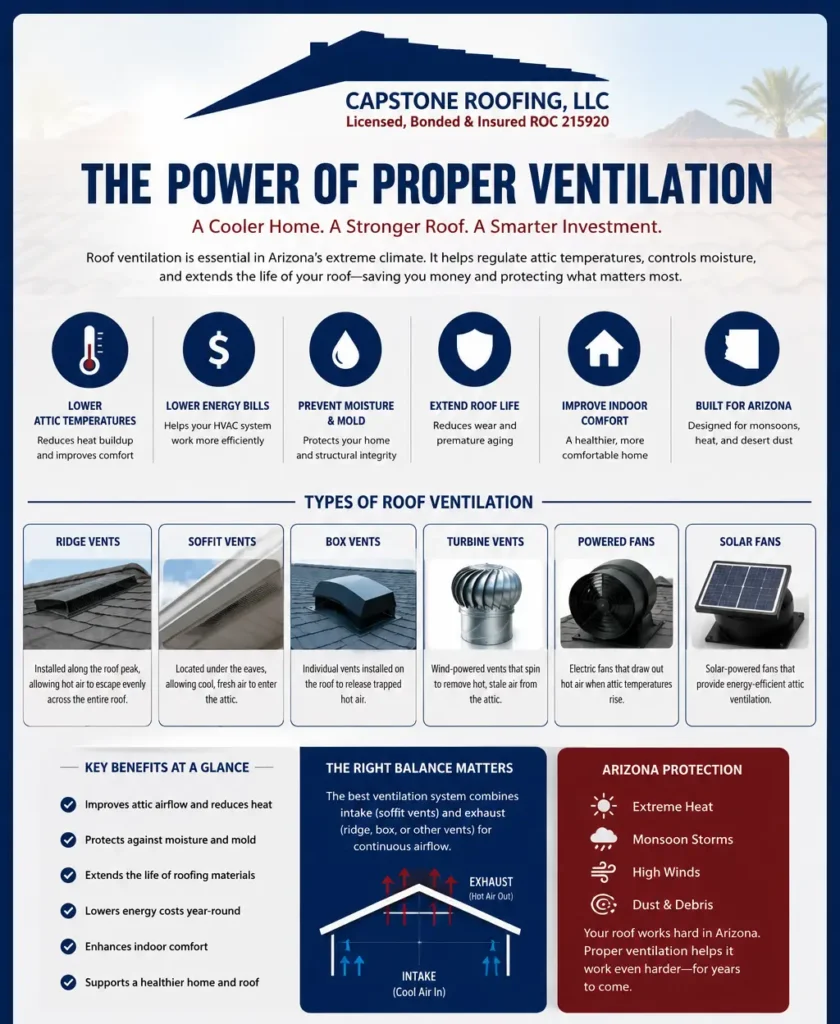
Roof ventilation is not simply about adding more vents. The best systems balance air entering through intake vents with warm air leaving through exhaust vents. When these components work together, fresh air continuously moves through the attic, carrying away heat and moisture before they create expensive problems.
Whether you own a home with asphalt shingles, tile roofing, foam roofing, or a commercial flat roof, understanding your roof ventilation options can help you make better decisions when replacing a roof, planning repairs, or improving your property’s energy efficiency.
This guide explains how roof ventilation works, the different types of roof ventilation systems available, when each option makes sense, and how Arizona’s climate influences the best choice for your property.
Quick Answer: What Is Roofing Ventilation?
Roofing ventilation is a system of intake and exhaust vents that continuously circulates air through your attic or roof assembly. Fresh outside air enters through intake vents—typically located near the soffits—while hot, humid air escapes through exhaust vents positioned near the highest point of the roof.
A properly balanced attic ventilation system helps:
- Reduce excessive attic temperatures
- Remove trapped moisture before mold develops
- Protect roof decking and framing from long-term damage
- Improve indoor comfort during every season
- Lower cooling costs by reducing heat transfer into living spaces
- Extend the life of roofing materials
- Help insulation perform more effectively
The goal is continuous airflow—not simply adding more vents. Proper placement, sizing, and balance between intake and exhaust determine whether a ventilation system performs efficiently.
Why Proper Roof Ventilation Matters More Than Most Homeowners Realize
Your roof is designed to protect the structure below it, but that protection depends on far more than shingles or tiles. The space beneath the roof covering plays an equally important role in keeping the entire system healthy.
Without adequate ventilation, heat and moisture become trapped inside the attic. Over time, that trapped air affects nearly every component of the roofing system, including insulation, wood framing, underlayment, roof decking, and even the roofing materials themselves.
Many roofing issues that appear to be caused by aging are actually accelerated by poor airflow.
Heat Build-Up Can Shorten Roof Life
Arizona summers create one of the harshest environments for roofing systems in the country. Even when outdoor temperatures reach “only” 110°F, attic temperatures can climb well above 150°F without adequate ventilation.
These extreme temperatures can:
- Age asphalt shingles more quickly
- Cause roofing materials to expand and contract excessively
- Increase wear on sealants and flashing
- Dry out underlayment prematurely
- Stress roof decking over many years
While roofing materials are engineered to withstand high temperatures, prolonged heat exposure places additional stress on the entire roof assembly.
Moisture Is a Year-Round Concern
Many people associate attic moisture with cold northern climates, but Arizona homes are not immune.
Everyday activities—including cooking, showering, laundry, and even breathing—release moisture into indoor air. If that moisture migrates into the attic and cannot escape, humidity gradually accumulates.
Over time, excess moisture may contribute to:
- Mold growth
- Mildew
- Wood rot
- Damaged insulation
- Rust on fasteners and metal components
- Reduced insulation performance
Monsoon season can further increase humidity levels, making effective attic ventilation even more valuable.
Lower Cooling Costs
A cooler attic places less demand on your home’s cooling system.
While ventilation alone will not dramatically reduce utility bills, reducing attic temperatures helps minimize the amount of heat transferred into ceilings and living spaces. Combined with quality insulation and a well-maintained roofing system, proper ventilation becomes part of an overall energy-efficient home.
If your roof is beginning to show signs of heat-related wear, it’s also worth learning how to identify roof damage before small problems become larger repairs.
Protecting Your Roofing Investment
A roof replacement represents one of the largest investments most property owners make.
Good ventilation helps protect that investment by reducing conditions that contribute to premature aging. Whether your roof is made of shingles, tile, foam, or another material, balanced airflow supports better long-term performance.
Ventilation should be viewed as one part of a complete roofing system rather than an optional upgrade.
How Roof Ventilation Actually Works
The concept behind attic ventilation is surprisingly straightforward.
Warm air naturally rises. As sunlight heats the roof throughout the day, attic temperatures increase rapidly. Without an escape route, that hot air remains trapped beneath the roof.
A properly designed roof ventilation system creates a continuous cycle:
- Cool outside air enters through intake vents.
- Fresh air moves naturally upward through the attic.
- Warm, humid air exits through exhaust vents near the roof peak.
- The cycle repeats continuously throughout the day.
This process relies on natural convection and pressure differences rather than mechanical equipment in most residential systems.
Intake Ventilation
Intake vents are usually installed beneath the roof overhang in the soffits. These vents allow cooler outside air to enter the attic.
Without sufficient intake ventilation, exhaust vents cannot function efficiently because there is little replacement air entering the system.
Think of it like drinking through a straw while covering the top of the cup—airflow becomes restricted.
Exhaust Ventilation
Exhaust vents are installed near the highest point of the roof where the hottest air naturally collects.
Common exhaust options include:
- Ridge vents
- Roof vents (box vents)
- Turbine vents
- Powered attic ventilation fans
- Solar-powered roof ventilation fans
The right exhaust system depends on roof design, local climate, attic configuration, and roofing material.
Balanced Airflow Is the Goal
One of the biggest misconceptions is that installing more roof vents automatically improves ventilation.
In reality, effective ventilation depends on maintaining a balance between intake and exhaust.
Too much exhaust without enough intake can actually reduce airflow by creating negative pressure. Likewise, abundant intake with limited exhaust allows heat to remain trapped inside the attic.
Professional roofers calculate ventilation requirements using industry standards based on attic square footage and roof design to achieve the proper balance.
Signs Your Roof Ventilation May Not Be Working Properly
Poor ventilation doesn’t always announce itself with an obvious roof leak. More often, homeowners notice subtle changes that gradually worsen over time.
Common warning signs include:
- Rooms that remain significantly hotter than the rest of the house
- Extremely hot attic temperatures
- High summer cooling bills
- Condensation or moisture inside the attic
- Mold or mildew on roof decking
- Rust forming around roofing nails
- Warping wood or deteriorating sheathing
- Premature aging of roofing materials
- Insulation that appears damp or compressed
Some of these symptoms may also indicate underlying roofing issues. Regular roof inspections and preventative maintenance help identify ventilation deficiencies before they lead to larger structural repairs. Following a consistent schedule of roof maintenance can also extend the overall lifespan of your roofing system.
Types of Roof Ventilation Systems
Not every roofing system uses the same type of ventilation. The ideal solution depends on your roof’s design, attic configuration, roofing material, insulation levels, local climate, and whether the property is residential or commercial. While many homes use a combination of intake and exhaust vents, the specific products installed can dramatically affect airflow and long-term roof performance.
Understanding how each ventilation option works makes it easier to choose a system that keeps your attic cooler, protects your roofing materials, and helps your HVAC system operate more efficiently.
Ridge Vents
Ridge vents are among the most effective passive ventilation systems available. Installed along the peak of the roof, they allow hot air that naturally rises to escape continuously across the entire ridgeline.
Because ridge vents extend nearly the full length of the roof, they provide even airflow instead of relying on a handful of isolated exhaust points. When paired with properly installed soffit vents, ridge vents create continuous air movement from the eaves to the roof peak.
Benefits of ridge vents include:
- Uniform ventilation across the attic
- No electricity required
- Minimal maintenance
- Nearly invisible appearance from the ground
- Quiet operation with no moving parts
- Excellent performance in Arizona’s hot climate
Many modern roofing systems are specifically designed around ridge ventilation because it provides consistent airflow while maintaining a clean roofline.
Box Vents (Roof Louvers)
Box vents, sometimes called static vents or roof louvers, are individual vents installed near the upper portion of a roof. Each vent allows trapped heat to escape naturally without the use of fans or mechanical components.
Unlike ridge vents, multiple box vents are spaced across the roof to provide adequate exhaust ventilation. The number required depends on the size of the attic and the amount of ventilation needed.
Box vents can be an excellent choice when:
- A home does not have a continuous ridge line
- Existing roofs are being retrofitted
- Roof geometry prevents ridge vent installation
- Only additional exhaust ventilation is needed
Although they can perform well, they generally provide less even airflow than a continuous ridge vent system.
Soffit Vents
Soffit vents are installed beneath the roof overhang and serve as the primary intake component of most ventilation systems. Their purpose is to bring cooler outside air into the attic as warmer air exits through the roof’s exhaust vents.
Without adequate intake ventilation, even the best exhaust vents cannot perform efficiently. Airflow depends on a balanced system where fresh air continuously replaces the warm air leaving the attic.
Properly installed soffit vents help:
- Maintain balanced airflow
- Reduce attic temperatures
- Prevent moisture accumulation
- Improve insulation performance
- Increase the efficiency of ridge vents and other exhaust systems
Blocked soffit vents caused by insulation, debris, bird nests, or improperly installed attic insulation are one of the most common causes of poor roof ventilation.
Gable Vents
Gable vents are installed near the peaks of exterior walls on the ends of a home. They allow air to move horizontally across the attic rather than vertically through the roof.
Older homes frequently rely on gable vents, and many continue to perform adequately when attic layouts are relatively simple. However, they typically provide less consistent airflow than balanced ridge-and-soffit ventilation systems.
Gable vents work best when:
- The attic has open, unobstructed space
- Wind conditions regularly move air through the openings
- The roof design limits other ventilation options
In complex roof designs with multiple valleys and separated attic spaces, gable vents alone often cannot ventilate every section effectively.
Turbine Vents
Turbine vents use wind energy to rotate a metal turbine mounted on the roof. As the turbine spins, it pulls warm air from the attic and exhausts it outdoors.
When wind conditions are favorable, turbine vents can move a significant amount of air. However, their performance depends heavily on local weather, making them less consistent than passive ridge ventilation.
Turbine vents offer several advantages:
- No electricity consumption
- High airflow during windy conditions
- Long service life with proper maintenance
- Suitable for many residential roof designs
Potential drawbacks include moving parts that eventually wear out, noise if bearings begin to fail, and reduced effectiveness during calm weather.
Powered Attic Fans: When Active Ventilation Makes Sense
Unlike passive ventilation systems that rely on natural airflow, powered attic fans use electricity to pull hot air from the attic when temperatures rise. These systems are often controlled by a thermostat, humidistat, or both, turning on automatically when conditions reach a preset level.
Powered fans can reduce attic temperatures more quickly than passive systems alone, making them attractive for homes that struggle with excessive summer heat or have ventilation limitations that cannot easily be corrected.
However, powered fans are not the right solution for every property. If intake ventilation is insufficient, a powerful attic fan may begin pulling conditioned air from inside the home instead of fresh outdoor air through the soffits. This increases cooling costs rather than reducing them.
Before installing a powered fan, it’s important to verify that the roof has adequate intake ventilation and that the attic floor is properly air sealed. During a professional roof inspection, contractors can identify whether ventilation improvements should come before adding mechanical exhaust.
Powered attic fans are commonly recommended when:
- Attics consistently exceed safe operating temperatures.
- Existing passive ventilation cannot achieve balanced airflow.
- The roof design limits ridge vent installation.
- Large attic spaces require additional air movement.
Even then, powered ventilation works best as part of a complete ventilation strategy rather than as a standalone fix.
Solar Attic Fans: Energy-Efficient Cooling for Arizona Homes
Solar-powered attic fans operate much like electric attic fans but are powered by rooftop solar panels instead of household electricity. Arizona’s abundant sunshine makes these systems particularly appealing because they typically run hardest during the hottest parts of the day—exactly when attic temperatures peak.
Many homeowners appreciate that solar attic fans require no additional electrical operating costs while still helping reduce heat buildup beneath the roof.
Potential benefits include:
- Reduced attic temperatures during extreme summer heat.
- Lower electrical operating costs.
- Less strain on HVAC equipment.
- Long service life with minimal maintenance.
Some premium models also include backup electrical power, allowing the fan to continue operating after sunset or during cloudy weather when additional ventilation may still be beneficial.
Solar attic fans are not a replacement for proper passive ventilation. Ridge vents, soffit vents, and adequate intake remain essential components of a balanced roofing system. Solar fans simply supplement that airflow when temperatures become excessive.
Comparing Popular Roof Ventilation Systems
| Ventilation Type |
Best For |
Advantages |
Potential Drawbacks |
| Ridge Vent |
Most modern homes |
Uniform airflow, low maintenance, nearly invisible |
Requires continuous soffit intake |
| Soffit Vent |
All roof systems |
Provides essential intake air |
Can become blocked by insulation |
| Box Vent |
Smaller roofs or retrofit projects |
Simple installation |
Requires multiple units for larger attics |
| Gable Vent |
Older homes |
Affordable and easy to install |
Less effective on complex roof designs |
| Turbine Vent |
Wind-prone areas |
High airflow without electricity |
Dependent on wind conditions |
| Powered Attic Fan |
Heat-intensive attics |
Strong airflow on demand |
Must have adequate intake ventilation |
| Solar Attic Fan |
Sunny climates like Arizona |
No electrical operating cost |
Works best alongside passive ventilation |
Choosing the Best Roof Ventilation for Arizona Homes
Arizona presents unique challenges that influence ventilation design. Summer attic temperatures frequently exceed 150°F, while monsoon storms introduce periods of high humidity followed by intense drying cycles. The right ventilation system must handle both extremes.
In most Arizona homes, the highest-performing configuration combines continuous soffit intake with ridge vent exhaust. This creates steady airflow across the entire underside of the roof deck, helping remove trapped heat while reducing moisture accumulation after storms.
Older homes often benefit from upgrades that replace aging gable or box vents with more balanced intake and exhaust systems. Homes that have undergone additions or multiple reroofing projects may also have ventilation layouts that no longer match the attic’s current size.
Roof material also plays a role. Tile roofs, shingle roofs, foam roofing, and low-slope systems each have different ventilation considerations. A contractor familiar with Arizona roofing conditions can determine whether the current design provides sufficient airflow or if modifications would improve long-term performance.
If your roof is approaching replacement age, ventilation improvements are often most cost-effective when completed alongside a new roofing system rather than as a separate project later. Many homeowners planning a replacement first review the available roof replacement options so ventilation upgrades can be incorporated into the overall design from the beginning.
Residential vs. Commercial Roof Ventilation: What’s Different?
Although the goal is always the same—moving heat and moisture out of the building—the best ventilation strategy depends heavily on the type of roof. Residential homes and commercial buildings often have completely different roof structures, insulation systems, and airflow requirements.
Selecting the wrong ventilation system can reduce energy efficiency, shorten roof life, and create maintenance problems that become increasingly expensive over time.
Residential Roofing Ventilation
Most Arizona homes use sloped roofs with enclosed attic spaces. Because of this design, ventilation typically relies on a balanced intake-and-exhaust system.
The most common configuration combines soffit vents along the eaves with ridge vents installed along the roof peak. As hot air naturally rises, it escapes through the ridge while cooler outside air enters through the soffits, creating continuous passive airflow.
Depending on the home’s design, contractors may also recommend box vents, gable vents, turbine vents, or solar-powered attic fans to improve performance where airflow is restricted.
During an inspection, it’s also common to evaluate attic insulation, roof decking, and flashing to ensure every component works together. Small ventilation issues are often discovered while performing a professional roof inspection, allowing homeowners to address problems before they become expensive repairs.
Commercial Roofing Ventilation
Commercial buildings present different challenges. Many have flat or low-slope roofing systems with minimal attic space—or none at all. Rather than ventilating a traditional attic, commercial systems often manage heat and moisture within the roofing assembly itself.
Depending on the building, ventilation may involve:
- Roof-mounted exhaust fans
- Mechanical HVAC exhaust systems
- Pressure relief vents
- Ventilated parapet assemblies
- Roofing systems designed to allow trapped moisture to escape
Warehouses, retail centers, office buildings, manufacturing facilities, restaurants, and multifamily properties each have unique ventilation requirements based on occupancy, equipment, and building use.
Commercial roofs also tend to experience much larger daily temperature swings because of their size and continuous sun exposure. Proper ventilation helps protect insulation, roofing membranes, rooftop equipment, and interior climate control systems from excessive heat buildup.
Common Roof Ventilation Mistakes to Avoid
Even quality roofing materials cannot perform as intended if the ventilation system is poorly designed or improperly installed. Many ventilation problems develop gradually, making them difficult to notice until they begin affecting comfort, energy bills, or the roof itself.
Installing Too Much Exhaust Without Enough Intake
One of the most common mistakes is adding additional exhaust vents without increasing intake ventilation. Exhaust vents cannot remove air efficiently unless replacement air is entering the attic.
Without adequate soffit ventilation, powered fans and ridge vents may simply pull conditioned air from inside the home, increasing cooling costs instead of reducing them.
Mixing Incompatible Ventilation Systems
Some homeowners assume that adding more vents automatically improves ventilation. In reality, combining multiple exhaust systems incorrectly can interfere with airflow.
For example, roof turbines, ridge vents, and powered attic fans may compete with one another instead of creating consistent circulation. A properly engineered ventilation system uses components designed to work together.
Blocking Soffit Vents
Insulation, storage boxes, or improperly installed attic flooring frequently block soffit vents. When intake vents become obstructed, the entire ventilation system becomes less effective.
Simple attic maintenance can often restore airflow without major roof modifications.
Ignoring Ventilation During Roof Replacement
A roof replacement provides one of the best opportunities to upgrade ventilation. Unfortunately, many homeowners simply replace shingles without evaluating whether the existing ventilation system still meets modern building standards.
Improving airflow during a roof replacement can increase the lifespan of the new roof while improving year-round comfort and energy efficiency.
Assuming Every Home Needs Powered Fans
Powered attic fans receive significant marketing attention, but they are not the best solution for every property. In many Arizona homes, properly balanced passive ventilation performs just as effectively with lower maintenance and no electrical costs.
A roofing professional can determine whether powered ventilation offers measurable benefits based on attic design, roof geometry, insulation, and existing airflow.
When Should You Upgrade Your Roof Ventilation?
Many ventilation systems remain unchanged for decades, even as roofing materials, insulation, and energy standards evolve. If your roof is more than 15 to 20 years old, it may no longer provide the airflow your home or business needs.
Consider evaluating your roof ventilation if you notice:
- Consistently high summer cooling bills
- Attic temperatures that feel excessively hot
- Uneven temperatures between floors
- Premature shingle deterioration
- Rusty attic fasteners or visible moisture
- Mold or mildew odors
- Ice dam history in colder climates
- Roof replacement planned within the next few years
Ventilation improvements often deliver their greatest value when combined with roofing upgrades, attic insulation improvements, or major home renovations. Addressing these systems together helps maximize long-term performance while avoiding duplicate labor costs.
For Arizona property owners, improving ventilation can also reduce the extreme attic temperatures that place additional strain on HVAC equipment throughout the summer.
Frequently Asked Questions About Roof Ventilation
How much roof ventilation does a home need?
Building codes generally base ventilation requirements on the square footage of the attic space, although the exact amount depends on factors such as vapor barriers, roof design, insulation levels, and local code requirements. The goal is to create a balanced system with adequate intake and exhaust rather than simply adding more vents. During a roof evaluation, contractors calculate the required net free ventilation area to ensure the system performs efficiently.
Can poor roof ventilation increase my energy bills?
Yes. In Arizona, trapped attic heat can raise temperatures well above 140°F during the summer. That excess heat transfers into the living or working space below, forcing HVAC systems to run longer. Proper ventilation helps reduce attic temperatures, allowing insulation to perform more effectively and improving overall energy efficiency.
Does every roof need ridge vents?
No. Ridge vents work exceptionally well on many sloped roofs, but they are not appropriate for every roof design. Flat roofs, low-slope commercial roofs, certain tile roofing systems, and complex roof layouts may require different ventilation strategies. The best solution depends on the structure, roofing material, and available intake ventilation.
Should roof ventilation be upgraded during a roof replacement?
In most cases, yes. A roof replacement is often the most practical time to correct ventilation deficiencies because roofing materials are already being removed. Improving ventilation during the project can extend the life of the new roofing system and help prevent future moisture or heat-related problems. If you’re planning a replacement, it’s worth reviewing your ventilation design alongside the roofing materials you choose.
Can roof ventilation prevent roof leaks?
Ventilation itself does not stop leaks caused by damaged roofing materials, flashing failures, or storm damage. However, it can reduce condensation that may otherwise be mistaken for a roof leak. Proper ventilation also helps prevent excessive heat buildup that can shorten the lifespan of shingles, underlayment, and other roofing components.
How often should roof ventilation be inspected?
Roof ventilation should be evaluated whenever a roof inspection is performed, after severe storms, and before major roofing projects. Homeowners should also periodically check that soffit vents remain unobstructed and attic insulation has not shifted to block airflow. Regular inspections help identify small issues before they affect the roof’s performance.
Choose a Roof Ventilation System That Matches Your Roof
There is no universal ventilation system that works for every property. The right solution depends on your roof’s design, the roofing materials, attic or ceiling configuration, insulation levels, and how the building is used. Arizona’s intense summer heat makes proper airflow even more important for protecting roofing materials and improving long-term energy performance.
Instead of focusing on adding more vents, the objective should be creating a balanced system that allows fresh air to enter while allowing hot, moisture-laden air to escape naturally. A properly designed ventilation system helps reduce heat buildup, minimizes condensation issues, and can contribute to a longer-lasting roof.
If your roof is showing signs of premature aging, unusually high attic temperatures, moisture concerns, or uneven indoor comfort, ventilation may be one of the first areas worth evaluating. Pairing routine maintenance with periodic inspections can help identify ventilation issues before they lead to more expensive roofing repairs. Our guide to spotting roof damage outlines several warning signs that property owners should watch for throughout the year.
Whether you’re maintaining an existing roof or planning a future replacement, understanding how roof ventilation works allows you to make better long-term decisions for your home or commercial building. A properly ventilated roof is an investment in durability, efficiency, and the overall health of the roofing system.
published on Monday, May 23rd, 2022