Built-Up Roofing vs. Modified Bitumen: Which Is Better for Arizona?
Built-up roofing and modified bitumen are two proven options for commercial flat and low-slope roofs. Both rely on asphalt-based waterproofing, both can provide multiple layers of protection, and both are commonly found on commercial buildings throughout Arizona.
But they are not interchangeable.
A built-up roof, or BUR, is constructed from multiple reinforcing plies combined with bitumen to create a layered membrane directly on the roof. Modified bitumen roofing uses factory-manufactured reinforced asphalt sheets enhanced with polymers such as SBS or APP.
For Arizona property owners, the better system depends on much more than the material name. Roof traffic, drainage, existing construction, installation method, UV exposure, surface reflectivity, rooftop equipment, maintenance requirements and the long-term plans for the property all matter.
This comparison breaks down built-up roofing vs. modified bitumen from the perspective of an Arizona commercial building owner so you can quickly understand where each system performs well, what it may cost and what should influence the final decision.
Built-Up Roofing vs. Modified Bitumen at a Glance
| Factor |
Built-Up Roofing (BUR) |
Modified Bitumen |
| Construction |
Multiple reinforcing plies and layers of bitumen assembled on the roof |
Factory-manufactured reinforced asphalt sheets modified with polymers |
| Common roof type |
Commercial flat and low-slope roofs |
Commercial flat and low-slope roofs |
| Typical planning lifespan |
Approximately 15–30 years depending on assembly, climate and maintenance |
Approximately 10–30 years depending on APP/SBS system, number of plies and maintenance |
| Typical cost positioning |
Often higher labor and installation requirements |
Often somewhat more installation flexibility, although total project costs vary widely |
| Primary strength |
Multi-ply redundancy and durable construction |
Flexibility, reinforcement and multiple installation options |
| Surface options |
Aggregate, cap sheet or compatible coating |
Granulated cap sheet, smooth membrane or compatible reflective coating |
| Roof traffic |
Very durable when properly surfaced and protected |
Good puncture and traffic resistance, especially with appropriate walkway protection |
| Installation options |
Traditionally hot asphalt and multi-ply application |
Torch-applied, cold-adhered, hot asphalt or self-adhered depending on system |
| Best suited for |
Buildings prioritizing multi-layer redundancy and robust construction |
Buildings needing an asphalt-based system with greater application flexibility |
These lifespan ranges are general planning benchmarks, not guarantees. Actual roof performance depends heavily on the membrane configuration, manufacturer, installation quality, drainage, UV exposure, maintenance, roof traffic and condition of the underlying assembly.
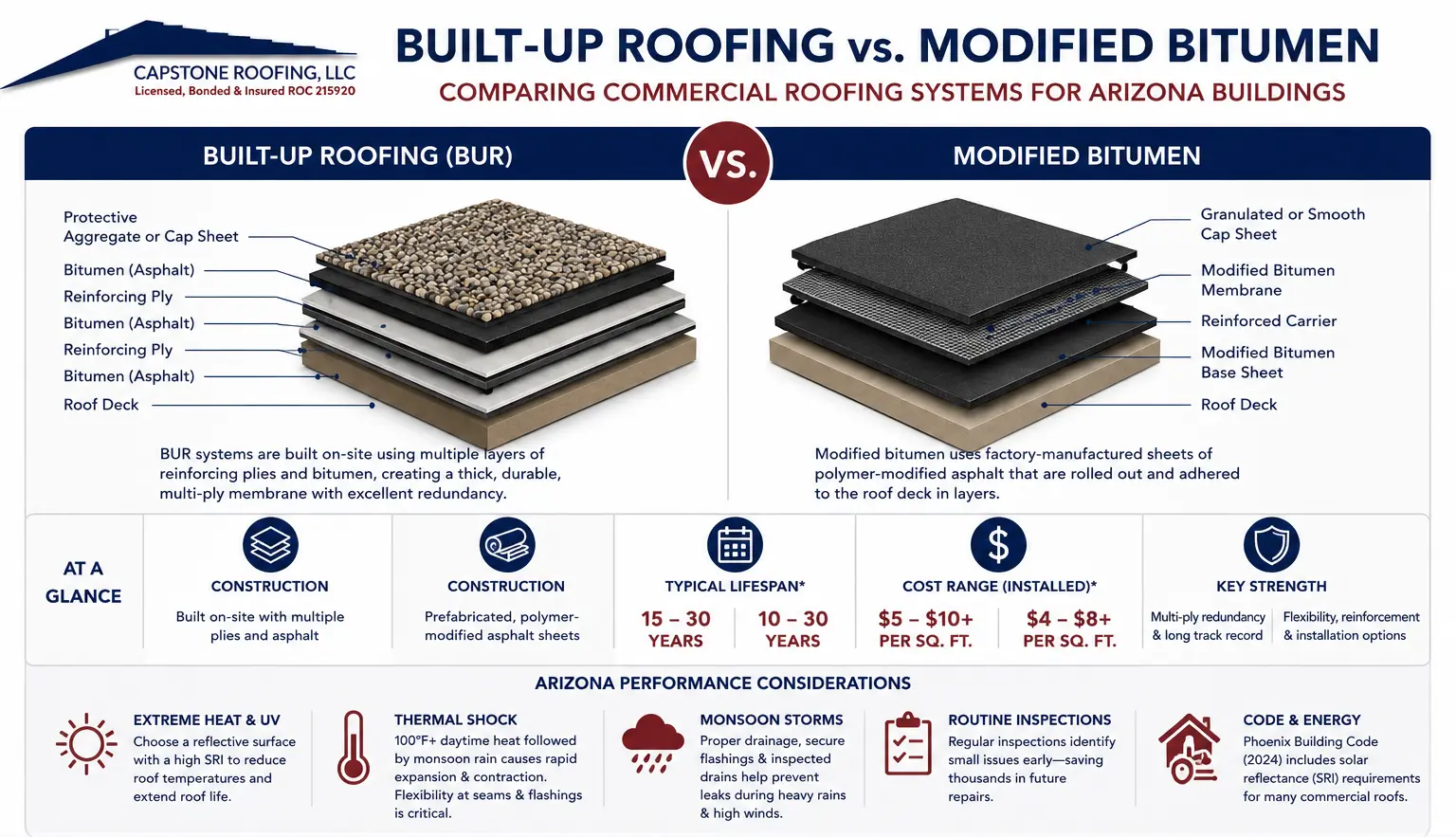
Quick Decision Guide: BUR or Modified Bitumen?
Commercial property managers rarely need another roofing definition. They usually need to know which direction makes sense for their building.
- If you want maximum multi-ply redundancy: Start by evaluating built-up roofing.
- If installation flexibility is important: Modified bitumen may offer more options, including cold-adhered, self-adhered and heat-applied systems.
- If your roof receives regular HVAC or maintenance traffic: Both can work well, but membrane protection and designated walkways should be part of the specification.
- If you already have a functioning BUR roof: Repair, restoration or another compatible bituminous assembly may be worth evaluating before complete replacement.
- If the building has numerous penetrations and complex details: Modified bitumen may offer useful application flexibility, although flashing design remains critical with either system.
- If solar heat gain is a concern: Focus on the finished roof surface, reflectivity, insulation and complete roof assembly—not simply BUR versus modified bitumen.
- If the existing roof has trapped moisture or damaged insulation: Neither membrane should be selected until those conditions are identified and addressed.
- If chronic ponding water is present: Fix the drainage issue first. A new membrane should not be expected to solve an improperly draining roof.
The best decision usually comes after evaluating the existing system rather than selecting a product first and trying to make the building fit it.
What Is Built-Up Roofing?
Built-up roofing is one of the longest-established roofing systems for commercial low-slope buildings.
Rather than relying on one manufactured membrane sheet, BUR creates the waterproofing layer by combining multiple reinforcing plies with bitumen. Each additional ply contributes another layer to the finished roof membrane.
A typical built-up roof may include:
- The structural roof deck
- Insulation
- A cover board where specified
- Multiple reinforcing plies
- Bitumen between the plies
- Flashings at penetrations, walls and curbs
- A protective aggregate surface, cap sheet or coating
This layered construction is the primary advantage of BUR.
Instead of depending on a single waterproof layer, the roof gains redundancy from multiple plies. That can make BUR particularly attractive for commercial and industrial buildings where durability and long-term protection are major priorities.
Where BUR Tends to Perform Well
Built-up roofing is often considered for large commercial roofs, industrial facilities, offices, warehouses and other low-slope buildings.
Its major strengths include:
- Multiple waterproofing layers
- Excellent system redundancy
- Long history of commercial use
- Durable surface options
- Good resistance to routine rooftop exposure when properly protected
- Ability to repair localized deterioration in many situations
The tradeoff is that BUR can be labor intensive. A multi-ply system must be assembled correctly across the entire roof, including flashing, drains, equipment curbs and transitions.
What Is Modified Bitumen Roofing?
Modified bitumen roofing is also an asphalt-based commercial roofing system, but its membrane is manufactured differently.
Instead of constructing all of the reinforcing layers separately in the field, modified bitumen incorporates reinforcement and polymer-modified asphalt into prefabricated roofing sheets.
The polymers alter the physical characteristics of the asphalt, producing membranes with properties that conventional roofing asphalt alone does not provide.
The two primary families are SBS modified bitumen and APP modified bitumen.
SBS Modified Bitumen
SBS stands for styrene-butadiene-styrene.
SBS modification gives the asphalt rubber-like or elastomeric characteristics. That makes SBS systems particularly notable for their ability to accommodate movement and remain flexible as the roof assembly expands and contracts.
This can be relevant in Arizona because commercial roof components repeatedly heat during the day and cool after sunset or during storms.
Depending on the manufacturer and roofing specification, SBS membranes may be installed using:
- Hot asphalt
- Cold-process adhesives
- Heat welding
- Self-adhered applications
APP Modified Bitumen
APP stands for atactic polypropylene.
APP modification gives asphalt more plastic-like characteristics and is commonly associated with membranes engineered for heat resistance and heat-applied installation.
APP membranes are particularly common in torch-applied roofing systems, although installation must always follow manufacturer requirements and applicable safety standards.
APP vs. SBS in Arizona
Property owners sometimes hear that APP is the “hot climate” membrane and SBS is the “cold climate” membrane. That is an oversimplification, but the distinction comes from real differences in polymer behavior.
APP-modified asphalt tends to perform well under elevated temperatures and is commonly used in heat-applied systems.
SBS-modified asphalt is especially valued for elasticity and low-temperature flexibility. That flexibility also becomes useful during repeated thermal movement because the membrane can better accommodate expansion and contraction.
Arizona does not simply expose roofs to heat. It exposes them to repeated thermal cycling, which means flexibility can be just as important as high-temperature performance.
The right choice therefore depends on the complete membrane specification rather than assuming APP always belongs in hot climates.
What Is the Main Difference Between BUR and Modified Bitumen?
The simplest distinction is:
Built-up roofing creates its multi-ply waterproofing membrane primarily by assembling reinforcing layers and bitumen on the roof. Modified bitumen uses reinforced polymer-modified asphalt sheets manufactured before installation.
That difference affects installation, material handling, repair methods and the range of available roof configurations.
Both systems can still be multi-layered. In fact, some commercial roofing assemblies combine conventional built-up plies with a modified bitumen cap sheet.
The choice is therefore less like comparing two completely unrelated materials and more like comparing two branches of asphalt-based commercial roofing technology.
Desert Performance: Heat, UV & Monsoons
This is where an Arizona comparison becomes more useful than a generic national roofing guide.
Commercial roofs in Phoenix and surrounding communities face three major environmental stresses:
- Intense solar radiation and prolonged UV exposure
- High roof-surface temperatures and repeated thermal cycling
- Sudden wind and rain during monsoon storms
Thermal Expansion and Arizona Thermal Shock
A commercial roof does not remain at one temperature throughout the day.
During an Arizona summer afternoon, a dark roof surface exposed to direct sun can become substantially hotter than the surrounding air. After sunset, the roof begins cooling. Then a monsoon storm can move across the Valley and rapidly cool an extremely hot roof surface with wind and rain.
This creates repeated expansion and contraction across the roofing system.
Different roof components can respond at different rates. The membrane, flashings, metal edges, penetrations, equipment curbs and structural materials all experience movement.
Over thousands of heating and cooling cycles, stress tends to concentrate around vulnerable details such as:
- Flashing transitions
- Wall connections
- Equipment curbs
- Roof drains
- Penetrations
- Membrane laps
- Changes in roof elevation
This is one reason membrane flexibility and high-quality flashing installation matter so much in the desert.
SBS-modified bitumen is particularly known for its elastomeric properties, while a properly designed multi-ply BUR system relies on its layered construction and reinforcement to manage roof stresses.
UV Exposure
Bituminous roofing should generally not be thought of as bare asphalt exposed indefinitely to Arizona sunlight.
Roof surfacing is an important part of protecting the waterproofing membrane.
Depending on the roofing system, that protection may come from:
- Mineral-surfaced cap sheets
- Aggregate
- Reflective coatings
- Other manufacturer-approved surfacing
Maintaining that protective surface becomes particularly important in Phoenix, where UV exposure is intense for much of the year.
Monsoon Rain and Drainage
Neither BUR nor modified bitumen should be selected as a substitute for proper drainage.
A low-slope commercial roof should move water toward drains, scuppers or other designed drainage points. Chronic ponding can accelerate deterioration and expose weak flashing or membrane details.
Before reroofing, contractors should investigate areas where water regularly accumulates.
Installing a new membrane over an unresolved drainage problem can simply carry the same defect into the new roof.
Property owners should also watch for clogged drains, damaged flashing and other common commercial roof problems before and after monsoon season.
Reflectivity, SRI and Phoenix Commercial Roofs
Roof temperature is not determined only by the membrane type.
The finished roof surface can have a major effect on how much solar energy the roof absorbs.
This is where terms such as solar reflectance, thermal emittance and Solar Reflectance Index, or SRI, become relevant.
SRI is a measure used to describe how well a roof surface reflects solar energy and releases absorbed heat. In general, a highly reflective roof has a higher SRI than a dark, highly absorptive roof.
The City of Phoenix has adopted the 2024 Phoenix Building Construction Code, including local energy-code provisions addressing roof reflectance and SRI. Requirements vary according to project and roof conditions, so owners planning a commercial reroof should verify the applicable code provisions for the building rather than assuming an existing roof specification still complies.
Built-up and modified bitumen systems can both incorporate reflective surface strategies in appropriate assemblies.
Possible approaches may include:
- Reflective cap sheets
- Light-colored granulated surfaces
- Manufacturer-approved roof coatings
Our guide to roof coatings for built-up roofs in Arizona explains some of the restoration considerations for existing bituminous systems.
A reflective roof can help reduce roof-surface temperature and heat transfer, but commercial energy performance depends on more than SRI alone. Insulation levels, HVAC efficiency, ductwork, building envelope performance and occupancy all influence actual cooling costs.
For that reason, property managers should be cautious about any roofing proposal promising a specific percentage of HVAC savings without evaluating the entire building.
Built-Up Roofing vs. Modified Bitumen Cost
Commercial roofing cost is one of the most searched parts of this comparison—and also one of the easiest numbers to oversimplify.
You may see general online planning ranges around:
| Roof System |
Broad Planning Range |
| Built-Up Roofing |
Often roughly $5–$10+ per square foot in broad national planning estimates |
| Modified Bitumen |
Often roughly $4–$8+ per square foot in broad national planning estimates |
These figures should not be treated as Arizona bids or guaranteed installed pricing.
Commercial reroofing costs can move considerably above broad material benchmarks once contractors account for:
- Removal of the existing roof
- Disposal
- Wet or damaged insulation
- Deck repairs
- Tapered insulation
- Drainage improvements
- Parapet and flashing work
- Rooftop equipment
- Roof access
- Crane requirements
- Number of membrane plies
- Surface coatings or cap sheets
- Manufacturer warranty requirements
- Building occupancy and jobsite restrictions
BUR can carry higher labor requirements because several roofing layers are assembled across the roof.
Modified bitumen may offer more flexibility in application method, but that does not guarantee it will be less expensive on every building.
The more useful comparison is total installed system cost—not the cost of a membrane roll or an advertised national price per square foot.
How Long Do BUR and Modified Bitumen Roofs Last?
Commercial roofing sources publish a wide range of expected service lives because there are many variations of each system.
A reasonable planning range is:
| System |
General Service-Life Planning Range |
| Built-Up Roofing |
Approximately 15–30 years |
| SBS Modified Bitumen |
Approximately 10–30 years |
| APP Modified Bitumen |
Approximately 10–20+ years |
These are not warranty periods and they are not guarantees.
Two roofs using the same product can age very differently.
Service life can be affected by:
- Number of membrane plies
- Manufacturer and system design
- Installation quality
- Roof slope
- Drainage
- UV exposure
- Surface protection
- Insulation condition
- Building movement
- Foot traffic
- Maintenance history
- Storm damage
- Previous repairs
A 17-year-old commercial roof with good drainage, intact flashing and documented maintenance may be in considerably better condition than a much younger roof with chronic ponding and neglected penetrations.
Age should therefore be treated as one factor in the repair-or-replace decision, not the only factor.
Which Roof Handles Foot Traffic Better?
Commercial roofs often serve as working areas for HVAC technicians, electricians and other service professionals.
That makes puncture resistance and traffic protection important.
BUR’s multi-ply construction and protective surfacing can provide strong resistance to normal rooftop exposure.
Modified bitumen also performs well where roofs experience maintenance traffic because the reinforced membrane is relatively robust compared with thinner single-ply systems.
Still, neither roof should be treated like a sidewalk.
Frequent access routes should include appropriate walkway protection where the roofing specification calls for it, particularly around:
- HVAC units
- Roof hatches
- Electrical equipment
- Solar equipment
- Service corridors
Managing foot traffic can substantially reduce avoidable damage regardless of which membrane is installed.
BUR vs. Modified Bitumen Installation
The installation process is one of the biggest practical differences between these systems.
Built-Up Roofing Installation
Traditional BUR uses alternating layers of reinforcement and bitumen to construct the membrane.
Hot asphalt has historically been closely associated with built-up roofing. The installation process can be labor intensive because several layers must be installed consistently across the roof.
Details at drains, penetrations, curbs and walls must be integrated into the complete system.
Modified Bitumen Installation
Modified bitumen membranes can support a broader range of application methods depending on the product.
These may include:
- Torch-applied installation
- Cold-process adhesive
- Hot asphalt
- Self-adhered membranes
- Heat-welded configurations
That flexibility can be valuable on occupied commercial buildings where project conditions make one installation method preferable to another.
Installation should always follow the manufacturer’s approved specification and applicable fire, safety and building-code requirements.
Which Is Easier to Repair?
Both systems can often be repaired without replacing the entire roof.
Modified bitumen sheets make membrane laps and individual sections easier to identify visually. A damaged area may be cleaned, prepared and repaired with compatible membrane materials.
BUR is also repairable. Damaged roofing can often be cut back and rebuilt using compatible plies and surfacing.
However, the visible defect is not always the real problem.
Recurring leaks can originate from:
- Wet insulation
- Failed flashing
- Drainage problems
- Roof movement
- Open penetrations
- Previous repairs
- Moisture trapped beneath the membrane
The best repair begins by determining why the roof failed rather than simply covering the visible symptom.
Maintenance Requirements for Both Systems
No commercial roof should be treated as maintenance-free.
Regular commercial roof inspections can identify deterioration before it spreads across a larger portion of the roof.
Areas that deserve routine attention include:
- Drains and scuppers
- Membrane laps
- Flashing
- Equipment curbs
- Penetrations
- Parapet walls
- Walkways
- Previous repair areas
- Coated surfaces
- Areas of ponding water
Arizona properties should also consider inspections after severe monsoon events, especially if the building experienced high winds, wind-driven rain or debris impact.
What About TPO?
BUR and modified bitumen are only two choices in modern commercial roofing.
TPO is a thermoplastic single-ply membrane commonly installed on low-slope commercial buildings.
Unlike BUR and modified bitumen, TPO is not an asphalt-based membrane. Its seams are typically heat welded, and white TPO membranes are commonly selected where roof reflectivity is an important consideration.
Commercial property owners considering modified bitumen should also review our comparison of TPO vs. modified bitumen roofing.
The question should not be “Which roofing material is best?”
It should be “Which complete roof assembly makes the most sense for this building?”
Can BUR and Modified Bitumen Be Used Together?
Yes. Some commercial roofing assemblies combine traditional built-up roofing components with modified bitumen.
For example, a roofing specification may use multiple built-up plies topped with a modified bitumen cap sheet.
This creates a hybrid assembly that combines multi-ply redundancy with the characteristics of a factory-manufactured modified membrane.
This is another reason simplistic BUR-versus-modified-bitumen comparisons can be misleading. Commercial roof systems can be configured in many ways.
Which System Makes More Sense for an Existing BUR Roof?
An existing built-up roof does not automatically need to be replaced with another built-up roof.
Before making that decision, a commercial roofer should determine:
- How many roofing layers are already present
- Whether the membrane contains trapped moisture
- Whether insulation is wet
- Whether the roof deck is sound
- How well the roof drains
- Whether deterioration is localized or widespread
Depending on the findings, the roof may be a candidate for localized repair, restoration, reroofing or complete replacement.
Some existing systems may also qualify for compatible coating or restoration solutions after appropriate preparation. Our guide to roof coatings for built-up roofs covers this topic in more detail.
When Built-Up Roofing May Be the Better Choice
BUR deserves serious consideration when:
- Multi-ply redundancy is a major priority
- The existing building already contains a compatible BUR assembly
- The roof experiences demanding commercial or industrial conditions
- A durable traditional bituminous system is preferred
- The building can accommodate the proposed assembly and installation process
BUR’s biggest advantage is not that it automatically lasts longer than every alternative. It is the robustness created by multiple layers working together.
When Modified Bitumen May Be the Better Choice
Modified bitumen may make more sense when:
- The project needs greater flexibility in installation method
- A reinforced sheet membrane fits the roof design
- The roof contains numerous transitions or details
- The property owner wants an asphalt-based system without a traditional full BUR installation
- SBS flexibility or APP material characteristics align well with the project requirements
The exact membrane specification still matters. Saying a building is receiving “modified bitumen” is not enough information by itself to evaluate the quality of the proposed roof.
Built-Up Roofing vs. Modified Bitumen: Which Is Better?
There is no universal winner.
Built-up roofing is strongest when multi-layer redundancy, durable construction and a long-established commercial roofing approach are priorities.
Modified bitumen is strongest when property owners want a reinforced asphalt system with polymer modification and greater flexibility in membrane and installation options.
For Arizona buildings, the final decision should place additional emphasis on:
- Thermal movement
- UV exposure
- Roof reflectivity
- Monsoon drainage
- Flashing flexibility
- Existing roof condition
- Rooftop traffic
- Long-term maintenance plans
Those factors usually matter more than choosing the roofing system with the most impressive advertised lifespan.
Questions to Ask Before Choosing a Commercial Roof
Before approving a BUR or modified bitumen proposal, ask:
- Is moisture present below the current membrane?
- Does any insulation need replacement?
- Is the roof deck structurally sound?
- Are there drainage problems?
- What exact membrane configuration is being proposed?
- Is the modified bitumen membrane SBS or APP?
- How many plies are included?
- How will wall, curb and penetration flashing be handled?
- What is the proposed roof surface or cap sheet?
- What solar reflectance or SRI does the finished assembly provide?
- Does the roof assembly meet the applicable Phoenix or local energy-code requirements?
- What manufacturer warranty applies?
- What workmanship warranty applies?
- How often should the roof be inspected?
A good commercial roofing proposal should identify the complete roofing assembly—not simply say “new flat roof.”
Choosing the Right Commercial Roofing System in Arizona
Built-up roofing and modified bitumen both have decades of commercial roofing history behind them.
BUR provides a robust multi-ply membrane assembled from reinforcing layers and bitumen. Modified bitumen takes asphalt roofing a step further by incorporating polymer modification and reinforcement into factory-manufactured sheets.
Arizona makes system selection particularly important because roofs face prolonged UV exposure, extreme summer temperatures, daily expansion and contraction, and sudden monsoon weather.
The membrane is only part of the answer.
Drainage, insulation, reflectivity, flashing, rooftop traffic and installation quality can have just as much influence on how well a roof performs.
Capstone Roofing provides commercial roofing services in Phoenix and throughout the Valley. Our team can evaluate the condition of an existing commercial roof and help property owners compare repair, restoration and replacement options based on the building rather than simply recommending one roofing system for every project.
Frequently Asked Questions
Is modified bitumen the same as built-up roofing?
No. They are both asphalt-based low-slope roofing systems, but their construction differs. BUR builds the membrane from reinforcing plies and bitumen installed on the roof. Modified bitumen uses prefabricated reinforced asphalt sheets enhanced with polymer modifiers.
What is better in Arizona: SBS or APP modified bitumen?
Neither is automatically better for every Arizona roof. APP membranes are known for high-temperature characteristics, while SBS membranes are valued for elasticity and flexibility. The roof design, application method, surface protection, thermal movement and manufacturer specification should determine which is appropriate.
What does BUR stand for?
BUR stands for built-up roofing. The name describes the process of building a waterproof membrane from multiple layers of reinforcement and bitumen.
How much does built-up roofing cost?
Broad national planning estimates sometimes place BUR around $5–$10 or more per square foot, but commercial roof replacement costs can vary substantially. Tear-off, insulation, deck damage, drainage, flashing, roof access and warranty specifications all affect final pricing. A site-specific commercial roofing estimate is much more useful than a national square-foot average.
How much does modified bitumen roofing cost?
Broad planning estimates commonly place modified bitumen around $4–$8 or more per square foot, but the actual installed cost can be considerably different depending on the roof. SBS versus APP, number of plies, tear-off, insulation, installation method and flashing requirements all affect pricing.
How long does a built-up roof last?
Commercial roofing references commonly place BUR within a broad range of roughly 15–30 years. Installation, membrane configuration, drainage, surfacing, maintenance and Arizona’s UV exposure can all shorten or extend actual service life.
How long does a modified bitumen roof last?
Modified bitumen systems commonly fall within a broad planning range of approximately 10–30 years depending on the membrane type and assembly. SBS, APP, number of plies, maintenance, drainage and surface protection all affect longevity.
Can modified bitumen be installed over built-up roofing?
Sometimes, but the existing roof needs to be evaluated first. Moisture, insulation condition, existing layers, deck condition and manufacturer requirements all affect whether a recover system is appropriate.
Are BUR and modified bitumen considered cool roofs?
Not automatically. Cool-roof performance depends heavily on the exposed surface. Reflective cap sheets and compatible coatings can increase solar reflectance and SRI for certain BUR and modified bitumen assemblies.
Which system is better for a commercial flat roof?
Both can be strong choices. BUR tends to appeal to owners prioritizing multi-ply redundancy, while modified bitumen provides reinforced sheets and several possible installation methods. The existing roof, drainage, traffic, budget and building requirements should guide the choice.
Should I repair or replace an aging commercial roof?
Localized membrane or flashing damage may be repairable when the rest of the roof remains in good condition. Widespread moisture, recurring leaks, deteriorated insulation or repeated repairs may make restoration or replacement more practical. A roof evaluation should determine how far the deterioration extends before that decision is made.
published on Friday, August 28th, 2026
