Is This a Roof Emergency in Arizona? How to Know When to Call a Roofer
Quick answer: You should call a roofer when roof damage allows water into your home, exposes roof layers, or worsens during Arizona monsoon storms. Stable, dry signs may allow short-term monitoring, but active leaks should not wait—especially when wind-driven rain is in the forecast.
Last updated for Arizona monsoon conditions: 2026
Roof problems don’t always announce themselves clearly. In Arizona—especially in the Phoenix Metro—homeowners often notice subtle signs like a new stain, a faint drip, or a shifted tile and wonder whether this is urgent or something that can wait.
This guide is designed to help you make that call calmly and confidently. You’ll learn what counts as an emergency, what can sometimes be monitored short-term, how monsoon conditions change the urgency, and what temporary steps are reasonable until a roofer can evaluate the issue.
What Counts as a Roof Emergency in Arizona?
A roof emergency is any situation where your roof is actively failing to protect the home and the damage is likely to worsen without prompt attention.
In practical terms, a roof issue is usually “emergency-level” when:
- Water is actively entering the home (dripping, running, or soaking materials)
- Roof layers are exposed (missing materials, lifted edges, punctures)
- Storm conditions are ongoing and could drive more water into the same weak point
- There is a safety concern (sagging ceiling areas, water near electrical fixtures)
If you’re unsure what you’re looking at, start with this overview of common ways to spot roof damage. It can help you identify whether the signs you’re seeing are cosmetic or potentially structural.
Decision summary: If water is actively entering the home or roof layers are exposed, treat it as urgent. If signs are stable and dry, you may have time to document and schedule an evaluation—unless a storm is approaching.

Why “Urgent” Can Change Faster in Phoenix Than You’d Expect
Roof issues in Arizona can accelerate quickly because local conditions create a very specific cause-and-effect chain.
- Extreme heat and UV exposure can dry and age sealants, flashings, and coating layers.
- Daily expansion and contraction can loosen fasteners, shift metal edges, and open small gaps over time.
- Monsoon wind-driven rain can push water into gaps that might not leak during a calm rain.
- Dust and debris can clog drainage points on flat roofs and create ponding during storms.
This is why two homes with the “same” issue can behave differently depending on roof type, roof age, and storm patterns. If you want local context on how storms affect roofs, this resource on roof weather damage in Phoenix is a helpful companion read.
Decision summary: A roof issue that seems minor on a clear day can become urgent quickly when monsoon winds arrive or when drainage is compromised on a flat roof.
Emergency Roof Repair vs Temporary Fixes: What’s Reasonable (and What Isn’t)
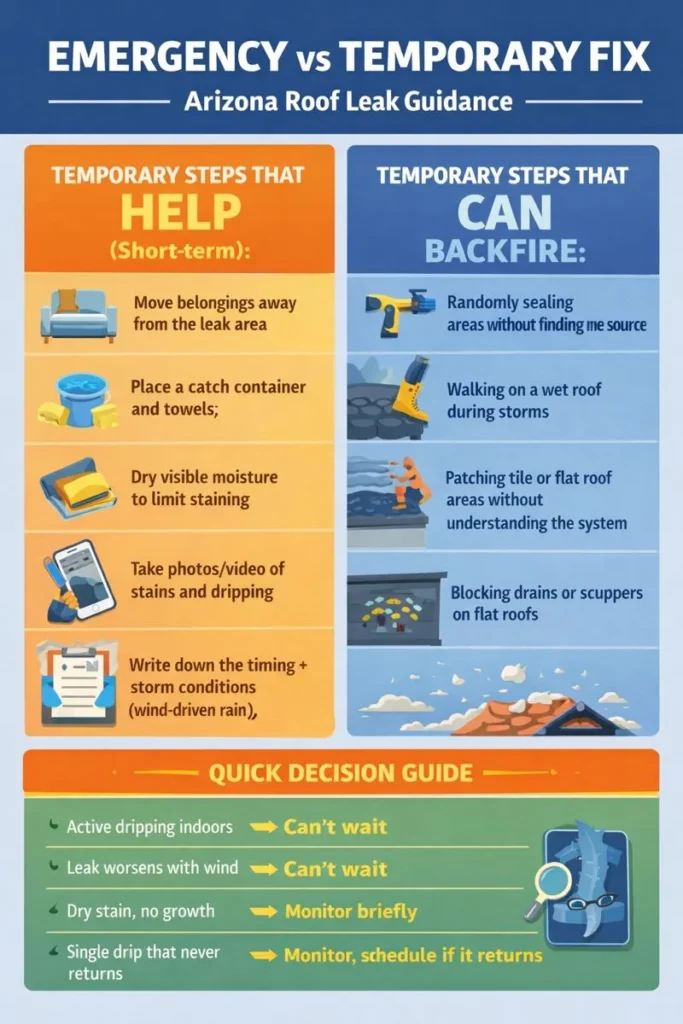
A temporary fix is meant to reduce interior exposure and stabilize the situation. It is not meant to “solve” the underlying cause, especially if the leak source hasn’t been confirmed.
Temporary steps that are often reasonable in the short term include:
- Moving belongings away from the leak area and placing a catch container
- Drying visible moisture to reduce staining and indoor humidity
- Taking photos/video of active dripping, ceiling stains, and any visible roof issues
- Noting the timing (what day, what weather, and whether it’s wind-driven rain)
Temporary steps that can backfire include:
- Sealing unknown leak areas with random caulk without identifying the source
- Walking on a wet roof during active storms (slip risk and potential roof damage)
- Trying to “patch” tile or flat-roof areas without understanding the roof system
Quick decision table:
| Situation |
Can it wait? |
Why |
| Active dripping or running water indoors |
No |
Ongoing water intrusion can spread quickly, especially during storms. |
| Dry stain with no growth after multiple weather events |
Possibly (monitor briefly) |
No active moisture is visible, but the source still should be evaluated if it returns. |
| Leak worsens with wind direction changes |
No |
Wind-driven rain can push water into vulnerable edges and flashing. |
| Single brief drip that stops and does not repeat |
Monitor (schedule if it returns) |
Some leaks are event-specific, but repeat leaking is a strong signal of a roof vulnerability. |
If you’re trying to determine where the leak is coming from, this guide on roof leak detection in Arizona explains why leak sources often show up far from the ceiling stain.
Decision summary: Temporary measures are about protecting the interior and documenting the situation. If you can’t identify the source or the leak is active, it’s time to involve a roofer.
Roof Leak During Monsoon Season: When It’s an Emergency vs When It Can Wait
A roof leak during monsoon season becomes more urgent because wind-driven rain can push water into vulnerable areas under roofing materials and flashing. That means the leak may not behave like a “normal” roof leak from a calm rainfall.
For local weather context, you can also monitor monsoon storm warnings from the National Weather Service, especially when wind and storm timing overlap with a known roof weak point.
Signs it’s likely urgent during a monsoon
- Active dripping or running water inside the home
- Leak becomes worse when wind direction changes
- Multiple new leak spots appear during the same storm
- Water near light fixtures, vents, or attic access points
Signs it may be stable enough to schedule (not ignore)
- A small stain that does not grow and remains dry after the storm
- A brief drip that stops quickly and does not return in the next storm
- No attic moisture and no repeat signs after multiple weather events
Decision summary: During monsoon season, treat active leaks and repeated leaks as urgent—even if the stain looks “small.” Wind-driven rain can turn small gaps into interior damage quickly.
Common Roof Emergency Scenarios in Phoenix Homes
In the Phoenix Metro, roof issues often become urgent for a few predictable reasons. These examples are common in local homes and commercial buildings, especially when heat and monsoon conditions overlap.
- Tile displacement that exposes underlayment: A few shifted tiles may not leak on a calm day, but monsoon winds can drive rain into vulnerable edges.
- Flat-roof ponding after dust and debris buildup: Blocked drains and scuppers can hold water longer, increasing the chance of seam and edge leaks.
- Flashing gaps that open with heat expansion: Small separations at penetrations (vents, skylights, transitions) can become active leaks when wind-driven rain hits.
- Debris impact during storms: Branches and wind-blown debris can puncture or disturb roof surfaces and edge details, creating immediate water entry points.
Decision summary: If a known weak spot is combined with wind-driven rain or compromised drainage, treat the situation as urgent even when interior symptoms start small.
Storm Roof Damage Warning Signs Homeowners Commonly Miss
Not all storm damage is obvious from the ground. Some of the most common “quiet” warning signs show up days later.
- Ceiling staining that slowly spreads: moisture can travel across framing before showing up inside
- Granules or debris in downspouts: can signal accelerated wear after storms
- New draft or dust patterns near ceiling lines: may suggest small openings or disturbed areas
- Loose flashing at roof edges or penetrations: often shows up as small leaks first
If you’ve noticed staining or discoloration inside, this article on brown spots on your ceiling breaks down common causes and what to look for next.
Decision summary: If you’re seeing new interior staining after a storm, don’t assume it’s “old” or “already dry.” Document it and plan for an evaluation, especially if another storm is in the forecast.
Roof Type Matters: Tile, Flat, Foam, and Metal Urgency Differences
In Arizona, roof type changes how quickly a small issue can become a bigger one. Here’s a practical way to think about urgency by roof system.
Tile roofs
Tile systems are durable, but the waterproofing layer underneath (underlayment and flashings) does the real work during rain. A shifted tile may not leak immediately—until wind-driven rain hits a vulnerable spot.
For homeowners who want a maintenance mindset, this guide on maintaining a tile roof explains common trouble spots that can become urgent during storms.
Flat roofs
Flat roofs can be especially time-sensitive if drainage is blocked. Ponding water can stress seams and edges, and repeated ponding can turn minor issues into active leaks.
Foam roofs
Foam systems depend heavily on their protective coating layer. If the coating is aged or compromised, UV and water exposure can accelerate wear.
Metal roofs
Metal roof leaks frequently relate to seams, fasteners, and flashing transitions. Small gaps may only leak under wind-driven rain.
Decision summary: Tile and metal issues can hide until monsoon winds expose weaknesses. Flat roof leaks can escalate quickly if drainage is compromised. Foam roof performance depends heavily on coating condition.
When to Call a Roofer (Decision Checklist)
You should call a roofer when the issue involves active water entry, exposed roof layers, repeated leak behavior, or storm-related changes that are difficult to evaluate safely from the ground.
Use this checklist:
- Call now if: water is actively entering the home, staining is spreading fast, or water is near electrical fixtures.
- Call soon if: the leak repeats in multiple storms, tiles appear shifted, or the roof looks disturbed after wind.
- Schedule an evaluation if: a stain remains dry and stable, and there are no repeat signs after multiple weather events.
For contractor verification and consumer guidance, the licensed roofing contractors registry maintained by the Arizona Registrar of Contractors is a helpful reference.
Decision summary: If your roof problem involves water entry or repeat storm behavior, it’s time to call. If it’s stable and dry, you may have time to document and schedule—without ignoring it.
Insurance & Documentation: What to Do Without Overcomplicating It
Many homeowners worry that they’ll “do it wrong” when storm damage is involved. Keeping it simple helps: document what you can see, note the timing, and avoid altering suspected damage areas unless needed to prevent interior exposure.
If you’re navigating coverage, this roof insurance claim guide explains common steps homeowners take and what insurers often want to see.
For general education on claims, the Insurance Information Institute provides a straightforward overview of insurance claim timelines and documentation basics.
Decision summary: Document first when safe, prevent interior exposure, and keep records of what happened and when. If the leak is active, prioritizing interior protection is reasonable.
What a Roofer Typically Checks (So You Know What to Expect)
Homeowners often feel more comfortable when they understand what a professional is evaluating. This resource on what roofers check during a roof inspection explains common inspection points and why they matter—especially after storms.
Decision summary: A good evaluation connects the interior symptom (like a stain) to the roof system cause (like flashing, underlayment, seams, or drainage).
Common “Wait and Watch” Scenarios (and When to Stop Waiting)
There are times when monitoring makes sense—mainly when the sign is stable, dry, and not repeating. The key is knowing when to stop waiting and schedule help.
Monitoring may be reasonable when:
- A small stain remains dry and unchanged for several weeks
- No attic moisture is present after storms
- No new symptoms appear after additional rain events
Stop waiting and schedule an evaluation when:
- The stain grows or becomes soft to the touch
- A drip returns in the next storm
- You notice new roof disturbance after wind
Decision summary: “Wait and watch” only works if the symptoms stay stable and dry. Any change in size, softness, repeat leaking, or storm disturbance is a signal to schedule help.
Practical Next Steps If You Believe Repair Is Needed
If you’ve determined the issue likely needs professional attention, it helps to understand what the repair decision process typically looks like. This page on how to prepare for a roofing project covers the basics—what to document, what questions to ask, and what to expect during planning.
If your situation involves an active or repeating leak, this resource on roof leak repair can help you understand typical repair pathways without guessing from symptoms alone.
Decision summary: Focus on clarity: document symptoms, understand the likely causes, and schedule an evaluation if the issue is active, repeating, or storm-related.
FAQs: When to Call a Roofer in Arizona
What is considered a roof emergency?
A roof emergency is active or worsening damage that allows water intrusion or exposes roof layers that protect your home. If water is entering living spaces, stains are spreading quickly, or roof components appear displaced after storms, it’s typically urgent.
Is a roof leak during monsoon season always an emergency?
A roof leak during monsoon season is urgent when water is actively entering the home or when wind-driven rain causes repeated leaking, even if the stain looks small. Stable, dry signs may allow brief monitoring, but repeat leaks should be evaluated.
Can I wait a few days to address a small ceiling stain?
You may be able to monitor a small ceiling stain if it stays dry and unchanged after multiple weather events. If it grows, becomes soft, or shows moisture again in the next storm, it’s time to schedule an evaluation.
What if the leak stops after the storm?
A leak that stops after a storm can still signal a roof vulnerability that only appears under wind-driven rain. If the symptom returns in another storm—or you notice new staining—document it and plan for an inspection rather than guessing.
Should I go on the roof to check damage?
It’s usually safer to avoid walking on roofs, especially when wet or during storms. Slips are common and roof surfaces can be damaged by foot traffic. Document what you can from the ground and indoors, then schedule a professional evaluation.
How do I know if water near a light fixture is serious?
Water near a light fixture should be treated as urgent because it suggests active intrusion near electrical components. Turn off power to the affected area if it’s safe to do so and avoid using the fixture until the issue is evaluated.
Do tile roofs leak right away if a tile shifts?
Not always. Tile roofs rely heavily on underlayment and flashing beneath the tile surface. A shifted tile can remain “quiet” until wind-driven rain finds a pathway underneath, which is why repeat storm behavior is an important signal.
Are flat roof leaks more time-sensitive?
They can be. Flat roofs may develop ponding when drains or scuppers are blocked, and standing water can stress seams and edges. If you see interior dripping, ceiling staining, or repeated leaks after storms, schedule an evaluation promptly.
Should I call insurance before calling a roofer?
If a leak is active, protecting the interior and documenting damage is the priority. Take photos and notes when safe. You can then use that documentation during the insurance process while avoiding unnecessary changes to suspected damage areas.
What information should I collect before I call a roofer?
Photos of interior symptoms, notes on when the issue started, and details about the weather (wind-driven rain, duration, and storm timing) are helpful. If you can safely see exterior disturbance from the ground, document that as well.
What’s the difference between a temporary fix and a real repair?
A temporary fix reduces interior exposure and helps prevent additional damage, but it does not address the roof system cause. A real repair resolves the underlying pathway for water entry—often involving flashing, seams, underlayment, or drainage details.
What if I’m not sure whether it’s a roof problem?
If you’re uncertain, document the symptom and consider an evaluation. Roof leaks can travel before showing up as a stain, and the visible spot may not be directly below the source. Repeat leaking after storms is a strong indicator.
published on Monday, January 12th, 2026


