How Roof Coatings Extend the Life of Built-Up Roofs in Arizona
Learn how reflective, elastomeric, and silicone roof coatings protect built-up roofs (BUR) from Arizona’s UV, heat, and monsoon rains—extending service life, cutting energy costs, and delaying full replacement.
Your roof has the toughest job of any part of your home or building. In Arizona, it faces triple-digit heat, year-round UV exposure, and sudden downpours during monsoon season. Over time, those conditions take a toll—especially on built-up roofs (BUR), which are common on commercial properties and some residential flat roofs across Phoenix and the Valley.Roof coatings provide a practical, cost-effective solution. Instead of tearing off and replacing a roof that’s starting to show wear, a professional coating can extend its service life by 10–20 years, improve energy efficiency, and protect it from the desert’s harshest elements. This guide explains how coatings protect BUR systems in Arizona, what benefits they bring, and what property owners should know before deciding.
Built-Up Roofs in Arizona: What They Are & Why They Struggle
Built-up roofing systems (BUR) use alternating layers of asphalt (bitumen) and reinforcing fabrics, often topped with a protective gravel layer. They’re durable by design, but Arizona’s climate accelerates wear and tear in several ways:
Intense UV radiation: Sun exposure breaks down asphalt layers via photo-oxidation, making the roof brittle and prone to cracking.
Extreme heat & thermal shock: Roof surfaces can exceed 150°F on summer afternoons, then cool rapidly at night. Daily expansion and contraction stresses seams and membranes.
Monsoon rain & ponding water: Flat and low-slope BUR systems often collect standing water during heavy storms, accelerating damage where surfaces are already weak.
Loss of gravel surface: High winds and flying debris can dislodge gravel, exposing asphalt to direct UV and speeding deterioration.
Without protection, a built-up roof in Arizona can degrade faster than its expected 20–30-year lifespan—especially under UV and ponding stress.
How Roof Coatings Solve These Challenges
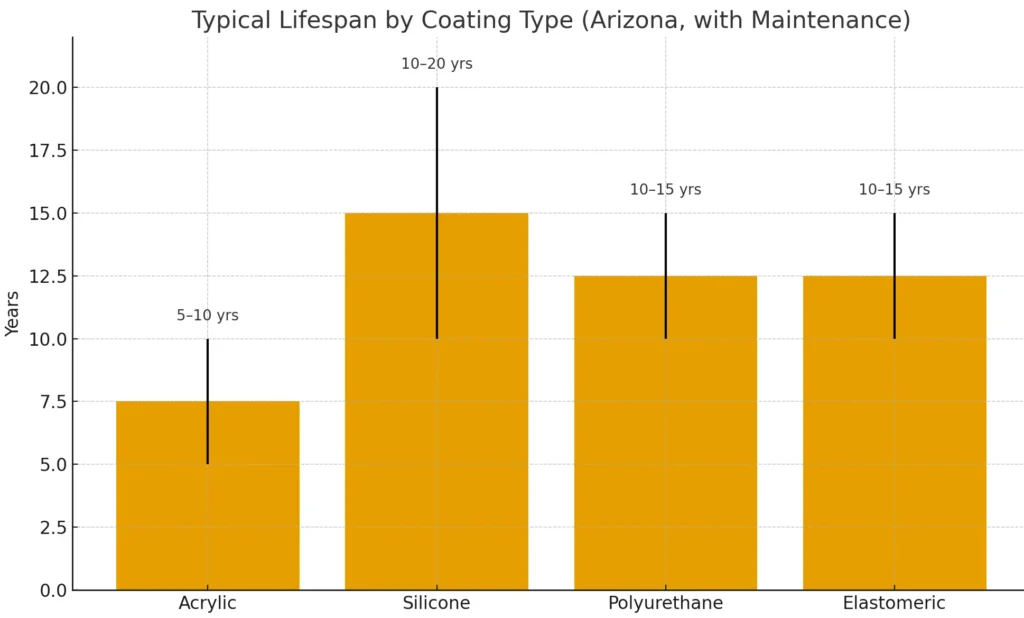
Liquid coatings applied over a BUR create a seamless, monolithic barrier designed to protect against the elements. Different coating types—elastomeric, acrylic, silicone—have specific strengths, but they all provide core benefits that matter in Arizona:
UV Protection & Durability
Reflective coatings bounce sunlight away from the roof, preventing UV rays from breaking down asphalt layers. High-reflectance systems can dramatically reduce surface temperatures (often up to ~50°F lower on hot days), slow photo-oxidation, keep asphalt flexible, and add years of service life.
Waterproofing & Ponding Resistance
Because coatings are applied as a liquid, they cure into a seamless, watertight membrane. Tiny cracks, seams, and pinholes that would normally let in water are sealed. Silicone coatings, in particular, are highly resistant to ponding water—critical for flat BUR roofs during monsoon season.
Thermal Shock Mitigation
Elastomeric coatings expand and contract with daily temperature swings, absorbing stress that would otherwise cause cracks in the asphalt membrane. By handling thermal movement, coatings reduce premature breakdown from Arizona’s hot days and cooler nights.
Extended Roof Life & Cost Savings
Instead of a costly tear-off and full replacement, coatings can add 10–20 years of performance to an existing BUR. For many property owners, that means deferring major capital expense while also enjoying lower energy bills and fewer repair calls.
Energy Efficiency & Reflectivity: Cutting Energy Bills in Arizona
Arizona is a cooling-dominated climate, so energy costs are driven mostly by the need to keep indoor spaces comfortable. Roof coatings directly reduce that burden:
Cooler roof surface: Dark BURs can reach 150°F+ in summer sun. Reflective white coatings can keep them dramatically cooler.
Lower HVAC load: Cooler roof surfaces reduce heat transfer indoors, so air conditioning systems don’t work as hard—cutting energy use and utility bills.
Longer HVAC life: Reduced workload lessens wear and tear on cooling equipment.
Lower peak demand: Savings are largest during the hottest hours when electricity rates are highest.
Independent studies of cool roof systems in hot climates (including Phoenix) have reported meaningful annual HVAC savings—with some findings around the ~20%+ range depending on building type, reflectivity, emittance, and operating schedule. When selecting products, look for both high solar reflectance and high thermal emittance (often summarized by an Solar Reflectance Index (SRI)) for maximum impact.
Roof Coating vs. Roof Replacement
When a roof begins to age, property owners often face a choice: repair, coat, or replace. Here’s a quick comparison to guide the conversation with your contractor:
Summary: Coatings add 10–20 years at a fraction of replacement cost, with minimal downtime and no tear-off waste.
| Factor | Roof Coating | Roof Replacement |
| Cost | Fraction of replacement | Significant capital expense |
| Added Lifespan | +10–20 years | 20–30 years (new roof) |
| Downtime | Minimal (days) | Weeks with tear-off/install |
| Waste | None (uses existing roof) | Tons of landfill debris |
| Energy Performance | Highly reflective options lower bills | Depends on selected materials |
Common Misconceptions & Mistakes
“Roof coatings fix any roof.” Coatings are not a cure-all. If a roof has major leaks, widespread water damage, or structural issues, replacement may be the safer choice.
“Coatings always work on shingles.” Many homeowners have reported poor outcomes when coatings were applied to shingle roofs. We focus coatings where they’re proven to perform—on flat and low-slope systems like BUR, foam, and certain metal roofs.
“Any coating will do.” Use acrylics where drainage is good and reflectivity is the goal; choose silicone where ponding water occurs. Proper compatibility and prep are critical.
“Coatings don’t last long.” With the right prep, installation, and maintenance, coatings routinely add 10–20 years of service life.
Maintenance After Coating: Keeping the System Performing
Bi-annual inspections: Ideally spring and fall—check for damage from UV and storms.
Keep drains clear: Remove debris to prevent ponding water.
Recoating plan: Expect a recoating cycle roughly every 10–15 years depending on system and exposure.
Professional checkups: Partner with a trusted contractor for adhesion, thickness, and waterproofing verification.
With proper care, a coated BUR can perform like new for decades.
Who Benefits: Homeowners vs. Building Owners
For Homeowners
Lower energy bills thanks to reflective surfaces that reduce heat absorption.
Leak prevention via a seamless waterproof barrier—especially helpful during monsoon season.
Delayed replacement to spread out major costs over time.
Capstone Roofing has protected Arizona roofs for more than 40 years. We follow NRCA standards on every project and choose materials adapted to Phoenix’s UV, heat, and monsoon conditions for long-term performance.
Experienced workmanship: Valley-tested crews and processes.
High-quality materials: Selected for longevity and climate fit.
Reputation you can trust: High ratings and reviews; memberships and certifications that align with industry standards.
Straightforward guidance: If a roof needs replacement, we’ll say so. If a coating makes sense, we’ll explain why.
FAQs
How many years does roof coating last?
Most roof coatings in Arizona last between 10 and 20 years when applied correctly and maintained. Coating type, roof condition, and regular inspections all matter.
How do you extend the lifespan of your roof?
Focus on preventative maintenance—regular inspections, timely repairs, and protective roof coating services. In Arizona, coatings can add a decade or more of reliable protection.
What is the lifespan of a built-up roof?
BUR systems typically last 15–30 years depending on installation quality, weather, and maintenance. With a professional roof coating, you can extend that by 10–20 years, delaying a full roof replacement.
Are roof coatings a good idea?
Yes—when applied to the right roof. Coatings are ideal for flat and low-slope systems like BUR, foam, and certain metal roofs. They improve durability, energy efficiency, and waterproofing against Arizona’s monsoon rains. For heavily damaged roofs, replacement may be the better long-term option.
Protect Your Built-Up Roof with Roof Coating Services in Phoenix
Arizona’s climate won’t go easy on your roof—but with professional coating services, you can extend its lifespan, save on energy costs, and avoid premature replacements.
Used to monitor number of Google Analytics server requests when using Google Tag Manager
1 minute
_gac_
Contains information related to marketing campaigns of the user. These are shared with Google AdWords / Google Ads when the Google Ads and Google Analytics accounts are linked together.
90 days
__utma
ID used to identify users and sessions
2 years after last activity
__utmt
Used to monitor number of Google Analytics server requests
10 minutes
__utmb
Used to distinguish new sessions and visits. This cookie is set when the GA.js javascript library is loaded and there is no existing __utmb cookie. The cookie is updated every time data is sent to the Google Analytics server.
30 minutes after last activity
__utmc
Used only with old Urchin versions of Google Analytics and not with GA.js. Was used to distinguish between new sessions and visits at the end of a session.
End of session (browser)
__utmz
Contains information about the traffic source or campaign that directed user to the website. The cookie is set when the GA.js javascript is loaded and updated when data is sent to the Google Anaytics server
6 months after last activity
__utmv
Contains custom information set by the web developer via the _setCustomVar method in Google Analytics. This cookie is updated every time new data is sent to the Google Analytics server.
2 years after last activity
__utmx
Used to determine whether a user is included in an A / B or Multivariate test.
18 months
_ga
ID used to identify users
2 years
_gali
Used by Google Analytics to determine which links on a page are being clicked
30 seconds
_ga_
ID used to identify users
2 years
_gid
ID used to identify users for 24 hours after last activity
24 hours
Google reCAPTCHA helps protect websites from spam and abuse by verifying user interactions through challenges.
Name
Description
Duration
_GRECAPTCHA
Google reCAPTCHA sets a necessary cookie (_GRECAPTCHA) when executed for the purpose of providing its risk analysis.
179 days
You can find more information in our Cookie Policy and .