
Why Phoenix Conditions Matter for Flat Roofs (Downtown to Desert Ridge)
If you manage property in Downtown Phoenix, Biltmore/Arcadia, Ahwatukee, Deer Valley/Desert Ridge, Glendale/Westgate, Peoria (P83), Tempe Town Lake/ASU, Scottsdale Airpark, Chandler’s Price Corridor, Mesa Riverview, Surprise City Center, or Fountain Hills, your roof faces the harshest mix in the Southwest: extreme heat and UV, thermal expansion/contraction, and intense monsoon downpours.
Pro Tip: Before monsoon season, schedule a flat-roof inspection to verify slope to drains, clear scuppers, and re-seal vulnerable penetrations.
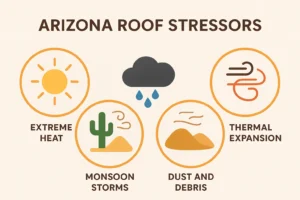
Arizona Roof Stressors (What Every Phoenix Property Endures)
- Extreme heat & UV: Roof surfaces can soar well above ambient temperatures, accelerating membrane aging and adhesive breakdown.
- Thermal cycling: Large day-night swings cause expansion/contraction, stressing seams and fasteners.
- Monsoon rain & ponding: Intense bursts challenge waterproofing and drainage (mid-June to late September).
- Dust & debris abrasion: Desert grit wears surfaces and clogs drains.
Checklist: Before and after monsoon, clear debris, check seams, inspect penetrations, confirm positive drainage, and document with photos for insurance.
Flat Roof Systems at a Glance
What Is Modified Bitumen?
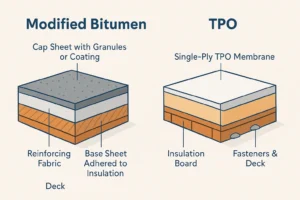
Modified Bitumen (Mod-Bit) is an evolved asphalt system enhanced with polymer modifiers (e.g., SBS/APP) and reinforced with fabric layers. It’s typically installed in multiple plies (base, mid, cap) using torch-down, cold-adhesive, or self-adhered methods. Multi-layer construction provides redundancy and ruggedness under heat, foot traffic, and mechanical equipment.
What Is TPO Roofing?
TPO is a single-ply thermoplastic membrane known for high reflectivity and heat-welded seams. It’s lightweight and efficient to install—popular for large, open commercial roofs where speed and cooling performance are priorities.
TPO vs. Modified Bitumen — How They Hold Up in Phoenix
Use this quick comparison to match each system to your building’s size, traffic, penetrations, energy goals, and maintenance preferences.
| Feature | Modified Bitumen | TPO |
|---|---|---|
| Layers | Multi-ply (2–3 layers) with polymer modifiers and reinforcement | Single-ply thermoplastic membrane |
| Reflectivity / Energy | Add white cap or coating for cool-roof performance | High reflectivity out of the box |
| Heat & UV Durability | Excellent under extreme heat; layered redundancy | Good; long-term UV stability depends on formulation and thickness |
| Waterproofing | Layered plies resist leaks; monitor ponding | Heat-welded seams are tight; punctures impact single ply |
| Foot Traffic / Puncture | Better abrasion and puncture resistance | More susceptible to punctures; add walkway pads |
| Install & Maintenance | Skilled torch/adhesive install; patches easily | Faster, lighter install; seams must be perfectly welded |
| Typical Lifespan | ~20–30 years with maintenance | ~15–25 years (membrane grade matters) |
| Best Fit | Small–mid roofs, many penetrations/equipment, frequent foot traffic | Large open roofs where speed and reflectivity are priorities |
Technical Notes for Arizona Specs
- Modified Bitumen: Specify SBS sheets meeting applicable ASTM standards; polymer modifiers improve elastic recovery and flexibility under heat/UV.
- TPO: Confirm membrane grade and thickness; review manufacturer data on reflectance, emittance, and warranty terms.
- Reflective performance (SRI): The Solar Reflectance Index combines reflectance and thermal emittance; coatings and white membranes can materially reduce heat load.
- Coatings & maintenance: Field-applied coatings are a proven maintenance strategy to boost reflectivity and extend service life.
Commercial Flat Roofing in Phoenix: From Arcadia to Scottsdale Airpark
Property managers across Downtown Phoenix, Arcadia/Biltmore, Desert Ridge/Deer Valley, Scottsdale Airpark, Tempe Town Lake/ASU, Chandler’s Price Corridor, Mesa Riverview, Glendale/Westgate, Peoria P83, Surprise City Center, and Fountain Hills face the same decision: Modified Bitumen for rugged, multi-ply protection, or TPO for fast installation and high reflectivity.
- For mixed-use buildings with many penetrations (curbs, RTUs, conduit) and regular foot traffic, we often recommend SBS Modified Bitumen with a reflective cap or coating. Explore roof coating services.
- For large, open warehouses where installation speed and cooling load are critical, 60–80 mil white TPO can be an effective choice—paired with a strong inspection program to maintain weld integrity. See commercial roofing and flat roof repair.
Why Good Drainage & Seam Integrity Matter After Storms
With periodic late-season storm surges in the Valley, designing for ponding resistance and scheduling post-storm inspections isn’t optional—it’s best practice. After any heavy event, clear debris, check seams and flashings, and document conditions.
FAQs
Which lasts longer in Arizona’s heat: TPO or Modified Bitumen?
Modified Bitumen generally has better aging resilience in heat due to its layered structure and polymer flexibility.
Can you coat a Modified Bitumen roof?
Yes. Applying a reflective elastomeric coating reduces heat absorption and extends membrane life.
Does TPO reduce cooling costs?
Yes—its inherent reflectivity can significantly lower summer cooling loads.
Which system handles monsoon storms better?
Modified Bitumen tends to be more forgiving in heavy rainfall if well-installed and flashed; TPO can perform well too when seams and details are flawless.
Need help choosing the right flat roof system for your building? We install both systems and tailor specs to Phoenix’s climate.
- Licensed, Bonded & Insured
- Locally Owned in Phoenix
- Decades of Arizona Roofing Experience